Why Meaningful Communication of HAI Information to Frontline Staff Matters | SMART Toolkit
Sharing HAI information with those who provide direct patient care is critical to maintain focus on infection prevention practices and support adjustment of behaviors to prevent infections.
Effectively communicating information about HAIs can engage frontline staff in efforts to prevent infections, as described by a study interviewee:
"…getting staff involved and showing them what the current metric is and what we're trying to achieve and getting their input on how we can help solve the problem because they're the ones that really do the work every day and they're the ones that gave us a lot of the solutions that we were then able to share data and track."
However, not all HAI information is useful for frontline staff. It is important to focus on HAI metrics and measures that are meaningful to this audience.
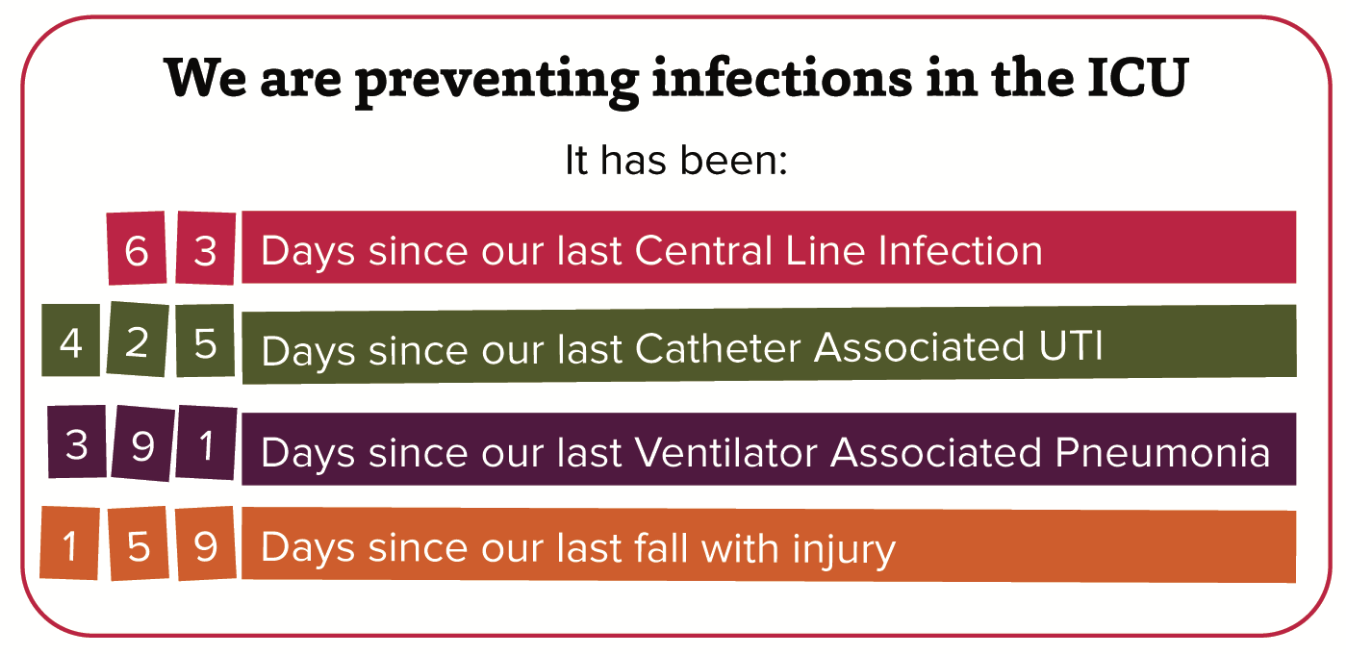
"… They might not have the CAUTI SIR ratio, but they have days since their last CAUTI, so that's more meaningful I think to the staff, rather than looking at a rate because you have to have like your goal, or whatever, so if the staff could look up and say, 'Oh my gosh, it's been 300 days since our last CAUTI.' That's pretty awesome."
Frontline staff need HAI information that:
- Relates to HAI prevention goals
- Allows prompt reaction to infections and timely feedback on infection prevention practices
- Is presented in a way that prompts discussion and maintains focus on infection prevention
- Is used to inform and improve infection prevention practices
This module provides guidance to those responsible for sharing HAI information with frontline staff to maximize the impact of communicating HAI information on the successful implementation of infection prevention practices.
Meaningful communication of HAI information can inform and empower frontline staff in their efforts to prevent infections.

Choosing Measures and Metrics
HAIs, and the infection prevention processes to prevent them, can be tracked in many ways. Measures and metrics created from HAI data can be used to understand successes and failures in reducing HAIs.
Common Measures and Metrics Include:
- Days since last infection
- Number of infections
- Infection rate
- Standardized infection ratio (SIR)
- Device days
- Utilization rate
- Standardized utilization ratio (SUR)
-
Infection prevention process information
(e.g., audit reports, number of Foley catheters removed with a nurse-driven protocol, etc.)
In our interviews, some measures and metrics were perceived as more meaningful to frontline staff than others. For example, measures and metrics such as days since last infection or numbers of infections were perceived as more meaningful to frontline staff than infection rates or standardized infection ratios.
When considering which measures and metrics to share with your frontline staff, the most meaningful and motivational information are those that:
Link Measures or Metrics to Goals
Major prevention goals should be linked to the measures and metrics for both the organization and the unit. This approach can signal the success or failure of infection prevention efforts and provide motivation to frontline staff.
We've gone 78 days without a CLABSI. We are almost to our unit goal of 100 days!
Report Measures or Metrics Over Time
Updating staff on current measures and metrics, in comparison with those from the past, can help frontline staff gauge the impact of changes to their infection prevention practices or identify areas for improvement.
Our unit had three CAUTIs this month; that's two more than we had last month. As a unit, let's make discussion of Foley catheter maintenance and removal a priority in huddles this month.
Provide Measures or Metrics Specific to the Unit and Individual
Measures and metrics specific to the unit and individual provide a focused view that can inform the improvement of local infection prevention practices. Providing unit level information helps identify the challenges and strategies specific to the patients and workflow of that unit. Providing individual level information (e.g., nursing scorecards) helps identify successful implementation of clinical practices, as well as errors in those practices. This information also helps identify successful areas and individuals, who can share best practices with the rest of the organization.
One of our nurses achieved 100% on their CLABSI dressing audits this month. They have shared with our unit their personal strategies for CLABSI dressing changes, which is helping others in the unit to improve their techniques.
Personalize Measures and Metrics by Associating Them with Patient Information
Identifying the personal impact of infections makes this information more meaningful to staff, who can recognize or recall the patient and reflect on what could have gone differently to prevent that infection.
Mrs. Smith that we took care of last week got a CLABSI- let's think about what we could have done to prevent this one so we can prevent the next one.
Share Information About Preventive Efforts, Not Just Infection Outcomes
Communicating measures and metrics of infection prevention practices (e.g., device days, device removal, hand hygiene) allows frontline staff to adjust their behaviors to prevent future infections, not just react to those infections that occur.
Our Foley utilization is higher than normal this month. Please be sure you are using the nurse-driven protocol to remove Foleys as soon as they are no longer medically necessary.
Determining the Frequency and Timing of Communicating HAI Information
The frequency and timing of communicating HAI information is important to keep frontline staff focused on infection prevention, to support timely reactions to infections, and to encourage real time adjustment of infection prevention practices to reduce HAIs in the future.
Different means of sharing HAI information may be suited to different frequencies of communication. Regardless of the frequency, delivering HAI information at consistent intervals helps demonstrate that HAI prevention is a priority and maintains focus on infection prevention processes.

- Daily - Provide updates on HAI measures and metrics in daily discussions in huddles or rounds. Inform frontline staff about confirmed infections as promptly as possible.
- Weekly - Update HAI information on bulletin boards and share unit performance in weekly emails.
- Monthly - Share scorecards monthly with hospital and unit information.
When considering the frequency and timing of communicating HAI information to frontline staff:
Update frontline staff daily with information to maintain engagement and motivation
Sharing HAI information on a daily basis demonstrates that infection prevention is a priority. Consistently sharing HAI information at daily huddles or rounds can help keep the focus on infection prevention practices.
No new infections to report today. Don't forget to assess your patients' Foley catheters and central lines for removal before the end of the shift.
Notify frontline staff about new infections as soon as possible
Promptly informing frontline staff about new infections is critical to support reflection and reaction to improve infection prevention practices. Identifying infections by recognizing the patient and their circumstances, rather than a statistic, can help emphasize the importance of infection prevention efforts.
Yesterday, we received confirmation that Mr. Smith developed a CLABSI. This means his hospital stay will be extended as we treat his infection. We will be meeting later today to do a deep dive into his care to identify what may have contributed to his infection. We'll follow up later this week to review any gaps in clinical practice.
Provide timely feedback that can impact infection prevention practices in real-time
Regularly updated HAI information can inform adjustments to improve infection prevention efforts. Sharing this information frequently allows frontline staff to adjust their work practices when areas for improvement are identified.
This week's audit report shows a decrease in our adherence to Foley catheter maintenance. What challenges have people experienced completing their Foley care in the past week that we can address to improve Foley care in the next week?
Selecting the Means of Communicating HAI Information
Choosing effective means of communicating HAI information can help to ensure this information reaches the frontline staff.
Common Means of Communicating HAI information include:
- Posting on hospital units - Share HAI measures or metrics on a bulletin board in break rooms or nursing stations.
- Emails - Send a monthly newsletter to summarize HAI information and recognize success in infection prevention.
- Scorecards - Include HAI information for the hospital, units, and individuals on monthly scorecards
- Dashboards - Provide current HAI information in an electronic format accessible to frontline staff.
- Discussions - Maintain a focus on infection prevention practices by discussing them daily in huddles or rounds.
When considering the means of communicating HAI information to frontline staff:
Make Information Easy to Find
-
Post information prominently in well-trafficked staff areas
(e.g., break rooms, nursing stations - Minimize "clicks" to navigate to electronic information
Make Information Easy to Understand
- Present counts, percentages, or simple rates, rather than ratios or other complicated measures
- Use colors to denote high performance (e.g., green) and low performance (e.g., red) on scorecards, bulletin boards, or newsletters
- Use charts or graphs to show change in performance over time
- Use visuals to relate measures and metrics to goals
| Quality Indicator | Unit | Target | YTD | J | F | M | A | ||
|---|---|---|---|---|---|---|---|---|---|
| Central Line-Associated Blood Stream Infections (CLABSIs) | |||||||||
| ICU | 0 | 1 | 0 | 0 | 0 | 1 | |||
| East | 0 | 0 | 0 | 0 | 0 | 0 | |||
| West | 0 | 1 | 1 | 0 | 0 | 0 | |||
| All Units | 0 | 2 | 1 | 0 | 0 | 1 | |||
| Catheter-Associated Urinary Tract Infections (CAUTIs) | |||||||||
| ICU | 0 | 1 | 1 | 0 | 0 | 0 | |||
| East | 0 | 0 | 1 | 0 | 0 | 1 | |||
| West | 0 | 0 | 0 | 0 | 0 | 0 | |||
| All Units | 0 | 3 | 2 | 0 | 0 | 1 | |||
Choose Means that Maintain Focus on Infection Prevention
-
Circulate HAI information by multiple means to reach all staff members
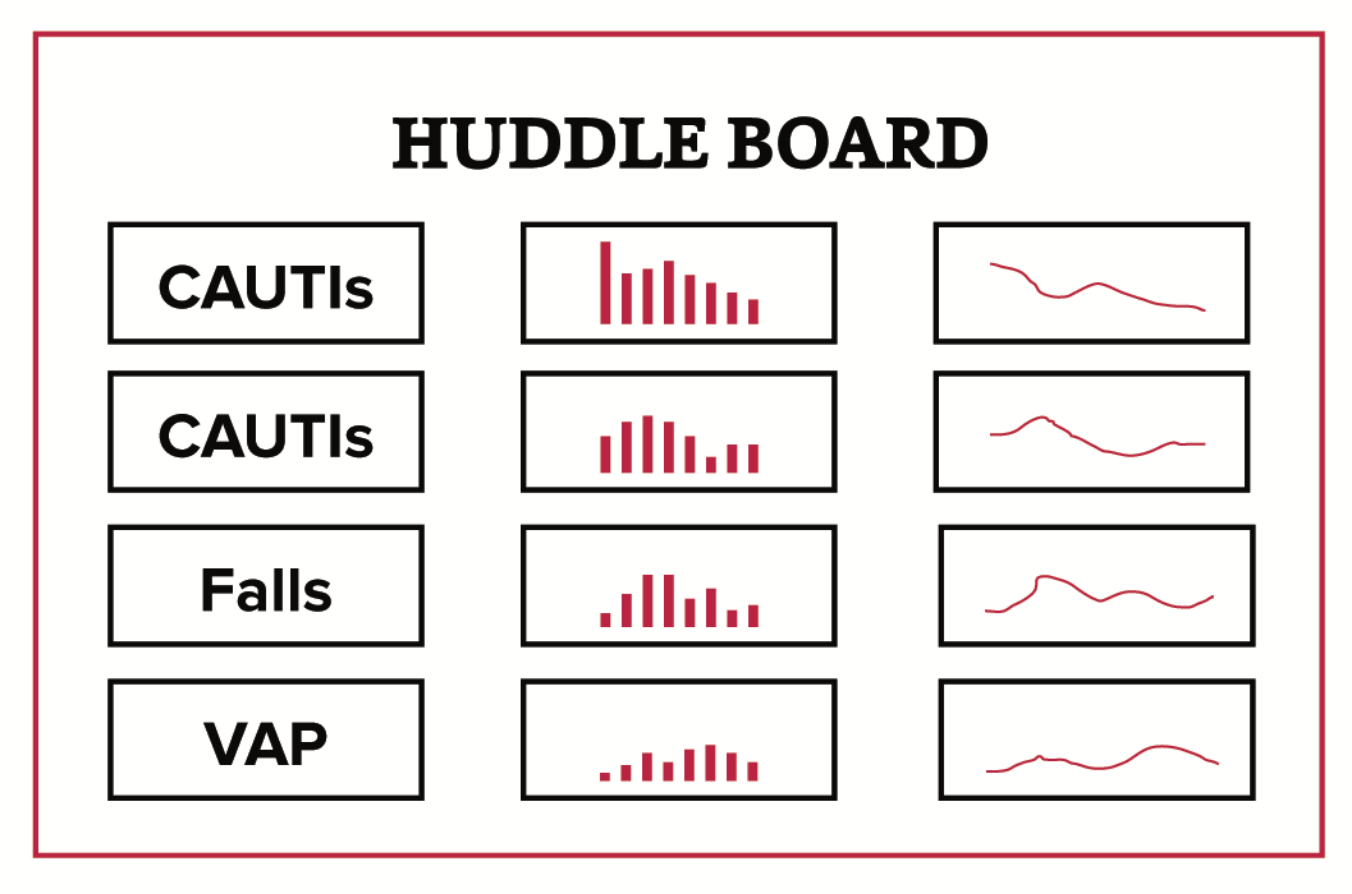
(e.g., email, postings, and in-person discussions) - Utilize huddles or rounding to discuss HAI information daily
-
Use other means of communication to direct and support daily discussions
(e.g., bulletin boards, dashboards)
Maximizing the Impact of Communicating HAI Information
Communicating HAI information can impact infection prevention processes through several mechanisms. To maximize the positive impact on infection prevention efforts, practices of communicating HAI information to frontline staff should:
Keep focus on infection prevention efforts
-
Promote ownership of HAI measures and metrics and accountability for infection
prevention
Provide HAI information at the unit and individual level to help convey that everyone's actions impact the prevention of HAIs. Promote accountability by being transparent about HAI information; let everyone see how everyone else is doing. Seeing evidence of good performance can foster pride in one's work, while seeing evidence of poor performance can fuel friendly competition to motivate improvement. -
Share and discuss HAI information regularly to keep infection prevention a priority
Make the reporting and discussion of HAI information a part of the routine in daily huddles or rounding. Talking about HAI information regularly shows that HAI prevention is a priority and can help maintain focus on infection prevention practices.
Identify areas for improvement in infection prevention practices
-
Provide feedback on adherence to infection prevention practices
Use HAI information to find where improvements can be made to infection prevention practices and guide actions to address these gaps. For example, if the Foley catheter utilization ratio has increased on a unit, react by reminding and re-educating frontline staff about nurse-driven protocols for catheter removal. -
Investigate infections to identify gaps in infection prevention practices
Use the identification of a new HAI as an opportunity to reflect on the care that patient received. Discuss with frontlines staff what could have gone wrong and what can be done in the future to prevent additional infections.
Motivate staff and celebrate their successes
-
Compare HAI measures and metrics to HAI reduction goals
Motivate infection prevention practices of frontlines staff by comparing current metrics and measures to unit- and hospital-level goals. Provide visual reminders of goals in relation to current metrics and measures (e.g., post the number of infections over time in relation to a maximum number of infections that a unit must stay below to meet their goal of reducing their infection rate from the previous year). -
Celebrate success with rewards and recognition
Let frontline staff know you appreciate their hard work by celebrating success. Give rewards, like a trophy or party, when infection prevention milestones are achieved (e.g., 365 days without a CLABSI). Provide recognition for exemplary infection prevention practices of individuals or units (e.g., share congratulatory messages in meetings or emails for units with outstanding hand hygiene adherence or for individuals that remove Foley catheters through nurse driven protocols).
Spread best practices identified through reporting of measures and metrics
- Identify successful units or individuals and share strategies to improve infection prevention practices Use HAI information to identify units and individuals that have been successful at implementing infection prevention strategies and reducing HAIs. Use these units and individuals as examples for others and a resource for strategies to successfully implement infection prevention practices.
How Different Team Members Can Support the Communication of HAI Data to Frontline Staff

Communicating HAI information to staff is a powerful tool to maintain focus on infection prevention, react to infections, and improve practices to reduce HAIs. As the team members that are often responsible for sharing this information with staff, Frontline Managers should consider the ways in which this information is most useful for their audience (e.g., posting measures in the break room or discussing metrics in daily huddles). Considering different aspects of communicating HAI information to staff can help identify missed opportunities in delivering information that can inform infection prevention work practices. These aspects include the metrics and means produced from HAI data, the frequency and means of communicating this information, and the impact that HAI information can have on the work practices of the staff.
Frontline managers have the power to engage their staff in infection prevention efforts through the communication of HAI information.
Infection Preventionists understand the breadth and complexity of the HAI metrics and measures they use to inform infection prevention efforts hospital-wide. Depending on the intended audience, however, not all HAI information is created equally. Metrics or measures used by Infection Preventionists, or meaningful to leadership, may not resonate with those providing patient care (e.g., standardized infection ratio (SIR)). Communicating the most meaningful information to frontline staff is critical to improving patient care work practices that can reduce HAIs. Infection Preventionists can help engage the frontline staff by making sure they have the right HAI information to motivate and inform their infection prevention efforts.
Infection preventionists use HAI information to communicate the importance of infection prevention to frontline staff.


Metrics and measures of HAIs are critical tools for Clinical Leadership as they evaluate performance in reducing HAIs and guide initiatives to improve HAI prevention. Likewise, frontline staff need pertinent information to indicate successes and failures in HAI prevention and inform changes to their clinical practices to reduce HAIs in the future. To best support frontline staff as the forefront of infection prevention, Clinical Leaders should be aware of the unique needs for dissemination of HAI information to this group.
Clinical Leaders can support the engagement of frontline staff in infection prevention efforts by setting expectations for communicating HAI information.
Exceptional Experiences
"…I feel like data is an important and very powerful tool because if you can see your own data and show it to people, they understand what you are up against and what you are working with."
"I think that the thing that we really do is getting staff involved and showing them what the current metric is and what we're trying to achieve and getting their input on how we can help solve the problem because they're the ones that really do the work every day and they're the ones that gave us a lot of the solutions that we were then able to share data and track. But we needed to get them involved on the front end of what the solution should even be."
"… if you go through any unit, you will see in their break room, they have everything highlighted on their walls, exactly what they're doing in terms of their CAUTIs. They might not have the CAUTI SIR ratio, but they have days since their last CAUTI, so that's more meaningful I think to the staff, rather than looking at a rate because you have to have like your goal or whatever so if the staff could look up and say, 'Oh my gosh, it's been 300 days since our last CAUTI. That's pretty awesome.' You're probably going to see that in some of the units."
"I think it's the partnership between the staff on the unit, and that educators and managers on the unit, and IP [infection prevention], it is very much seen as a collaborative partnership. We try to provide outreach to them in a way that's meaningful to them, we provide data in a way that's meaningful to them because if it looks great to us but makes no sense to them it's not valuable, so we really try to take our cue from what the units want and go down to the unit level. You can't really… It's hard to tackle it at a hospital level, you can have a goal and the target, but you have to get down to the unit level to make the change."
"We have huddle boards. So we do safety huddles twice a day. We have a number of things that we track daily, and then we will report out, our charge nurses will report to the oncoming shift as far as what's going on with some things. In addition to that that's where myself and the assistant manager will post different things as well. So we've got you know the number of days since we've had a central line infection, we will report if we have a CAUTI, we'll share with them if we're trending up or we're trending down as far as utilization goes. Things like that, so we try and talk about all of those things with the entire unit just to kind of keep the awareness at the forefront."
Communicating HAI Information to Frontline Staff Facilitator Guide
Facilitator Guide: Complete
Portable Document Format (PDF)
This facilitator guide is designed to help you understand how to maximize the impact of communicating HAI information to frontline staff to support infection prevention efforts at your hospital.


Facilitator Companion Presentation Slides
PowerPoint Document (PPTX)
The objective of this presentation is to provide guidance to those responsible for sharing HAI information with frontline staff to maximize the impact of communicating HAI information on the successful implementation of infection prevention practices.
Communicating HAI Information to Frontline Staff Tools
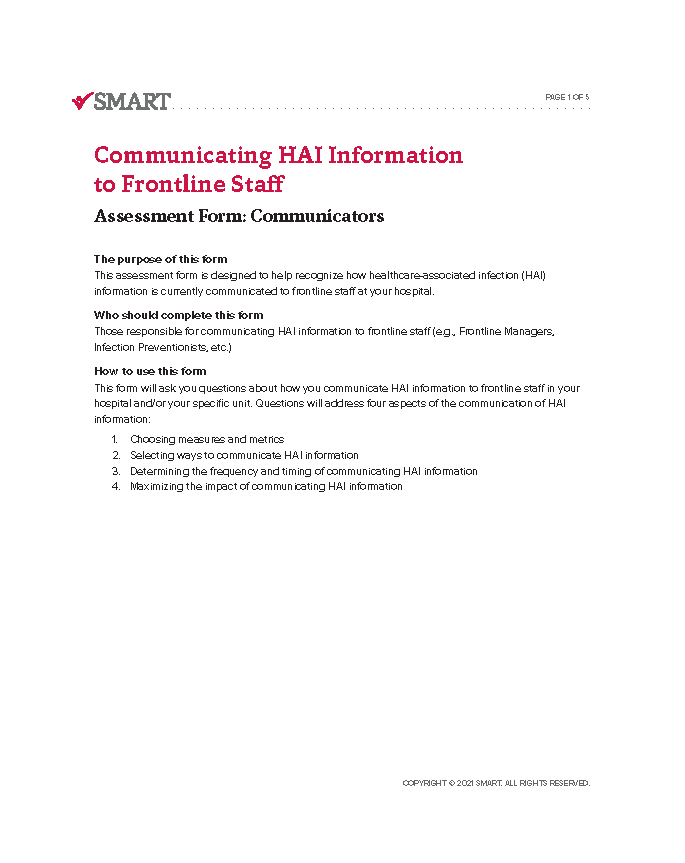
Communicating HAI Information to Frontline Staff Assessment Form - Communicators
Portable Document Format (PDF)
This assessment form is designed to help recognize how healthcare-associated infection (HAI) information is currently communicated to frontline staff at your hospital.
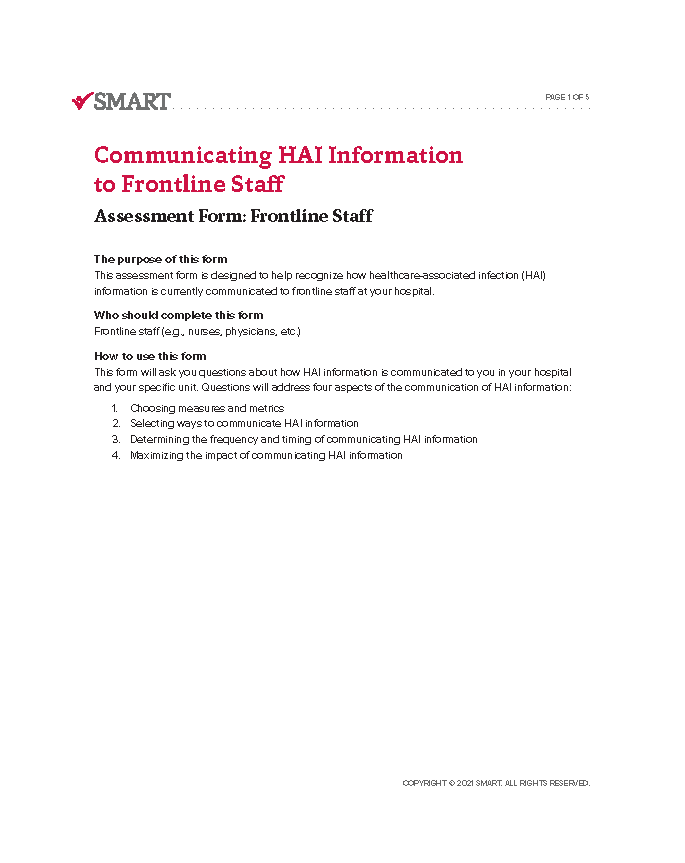
Communicating HAI Information to Frontline Staff assessment Form - Frontline Staff
Portable Document Format (PDF)
This assessment form is designed to help recognize how healthcare-associated infection (HAI) information is currently communicated to frontline staff at your hospital.
Communicating HAI Information to Frontline Staff Activity
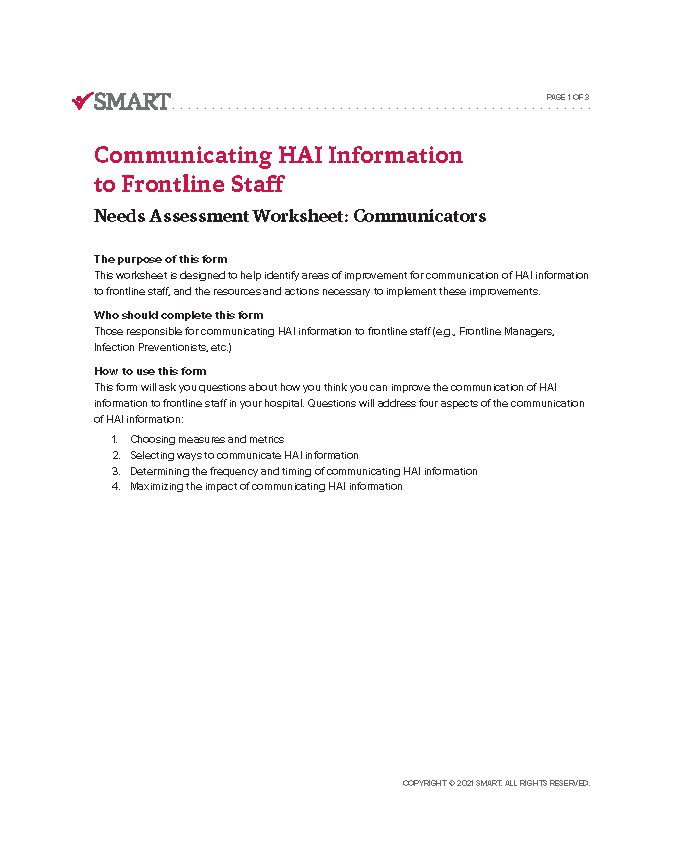
Communicating HAI Information to Frontline Staff Needs Assessment Worksheet - Communicators
Portable Document Format (PDF)
This worksheet is designed to help identify areas of improvement for communication of HAI information to frontline staff and the resources and actions necessary to implement these improvements.
Works Cited & References
-
The NHSN Standardized Infection Ratio (SIR)
https://www.cdc.gov/nhsn/pdfs/ps-analysis-resources/nhsn-sir-guide.pdf -
The NHSN Standardized Utilization Ratio (SUR)
https://www.cdc.gov/nhsn/pdfs/ps-analysis-resources/nhsn-sur-guide-508.pdf - McAlearney AS, Hefner JL. Facilitating Central Line-Associated Bloodstream Infection Prevention: Qualitative Study Comparing Perspectives of Infection Control Professionals and Frontline Staff. Am J Infect Control. 2014;42:S216-S222.