What are Tiered Huddles? | SMART Toolkit
Tiered Huddles are daily meetings that occur across multiple levels (tiers) of leadership within an organization to facilitate communication across those tiers. Team Huddles occur within each tier to check the status of work, identify problems, take countermeasures such as escalation, and ensure that issues are addressed.
Effective Tiered Huddles consist of "teams of teams" across the organization engaging in a set of standardized and complementary practices.
There are individuals who span multiple adjacent tiers and this helps promote accurate communication of information and appropriate escalation between tiers, with the most critical issues being quickly escalated to higher tiers.
Tiered Huddles take place within and across different tiers (i.e., levels) of a hostpital.
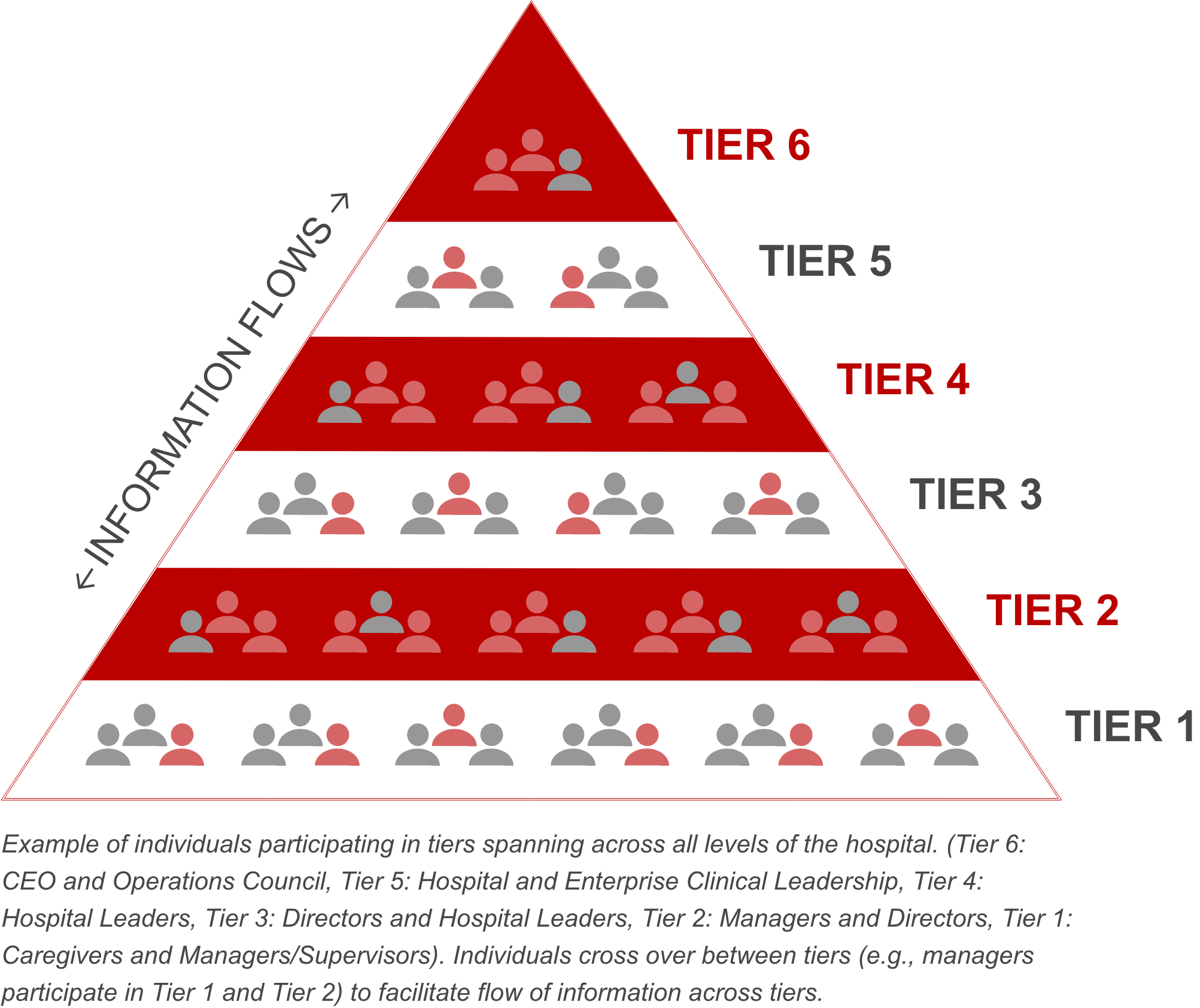
An Example Of Tiered Huddles In Practice
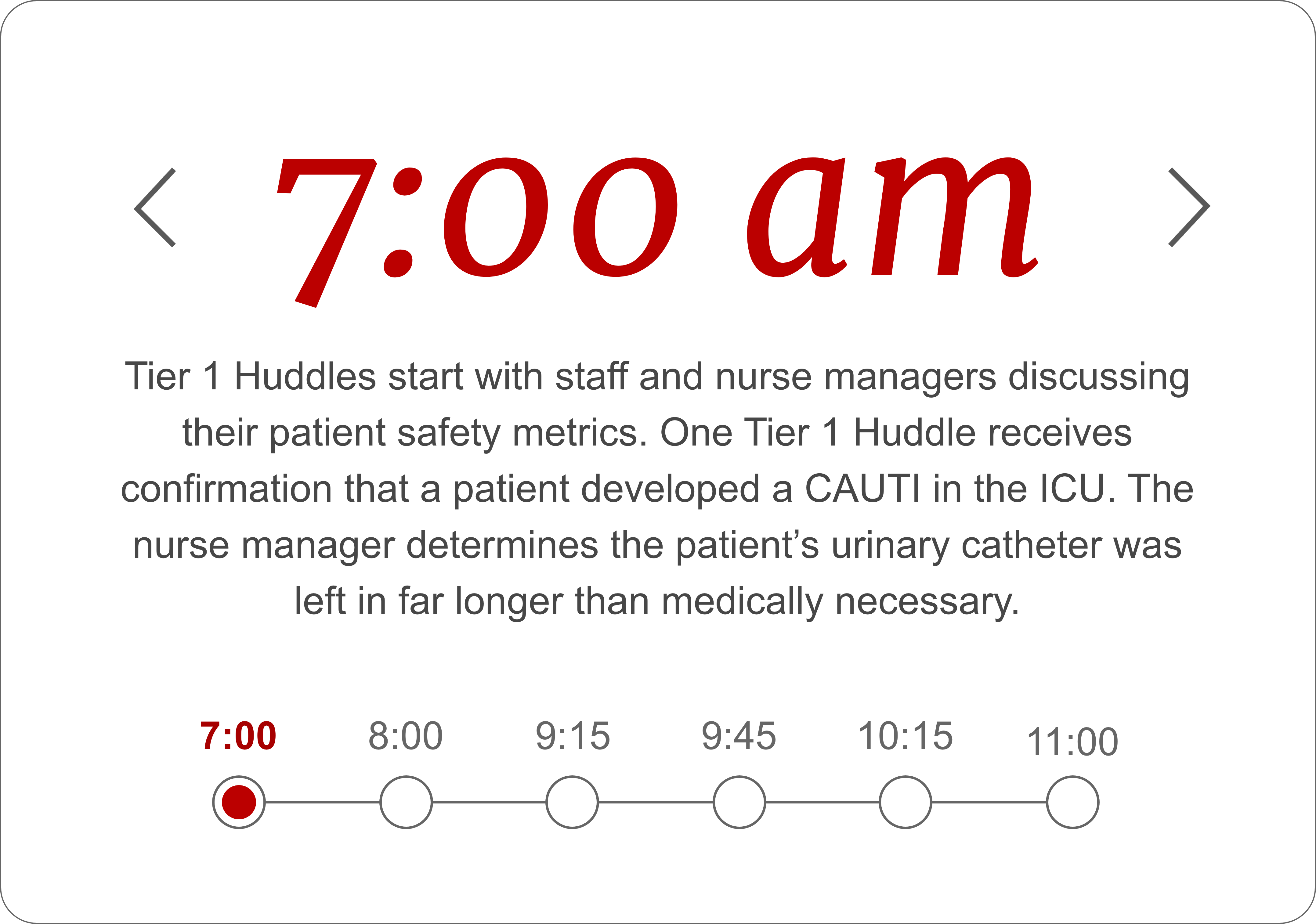
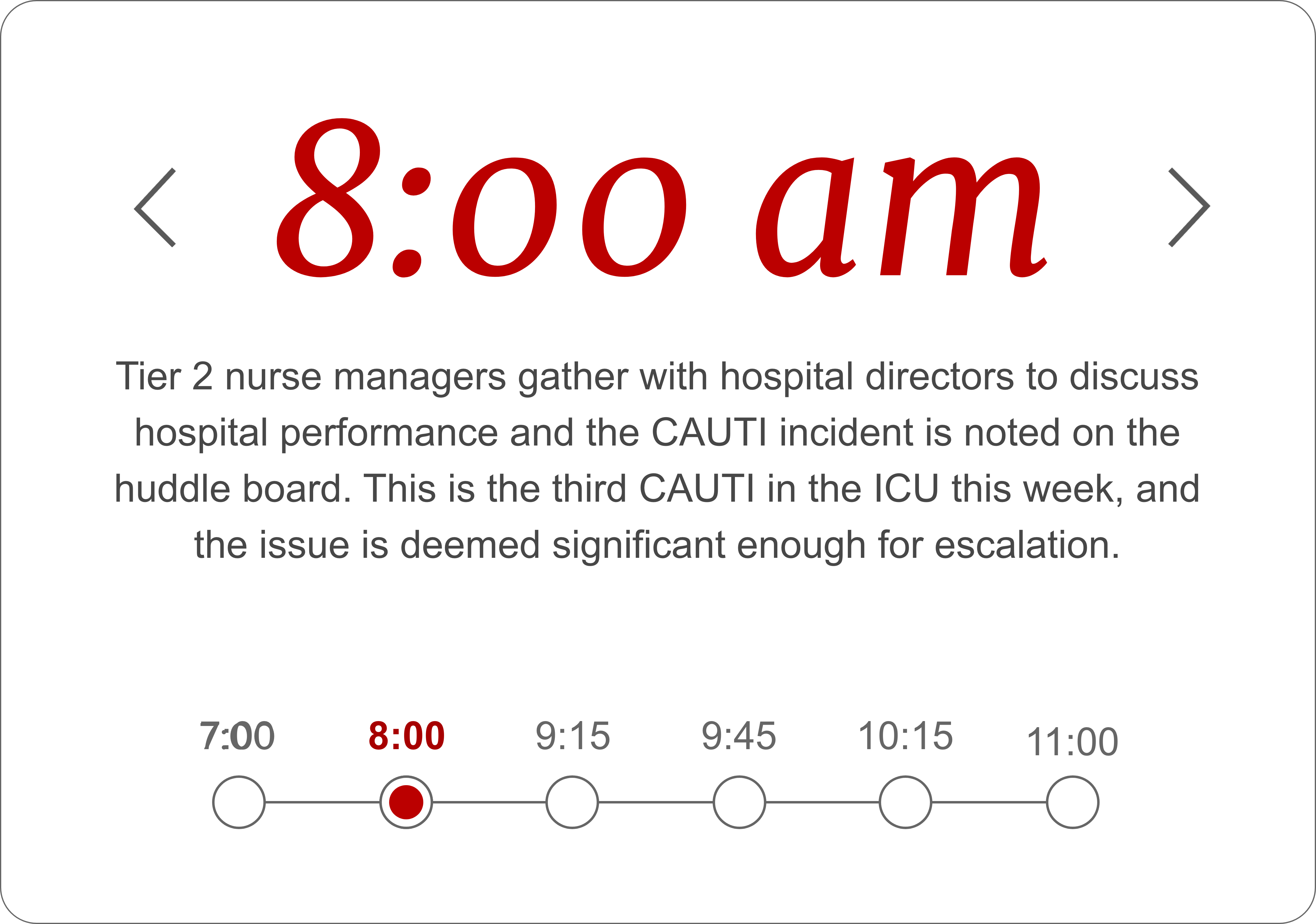
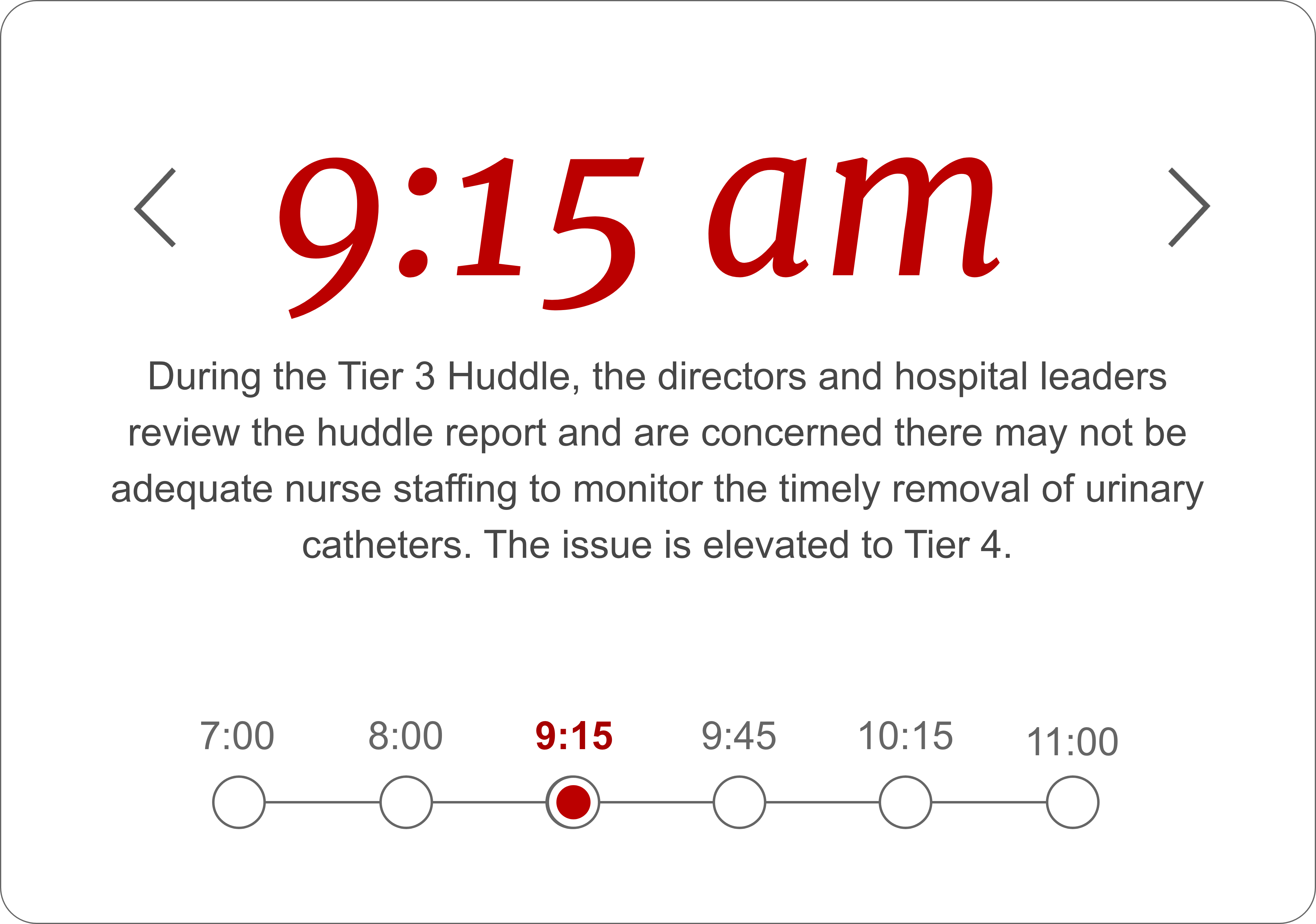
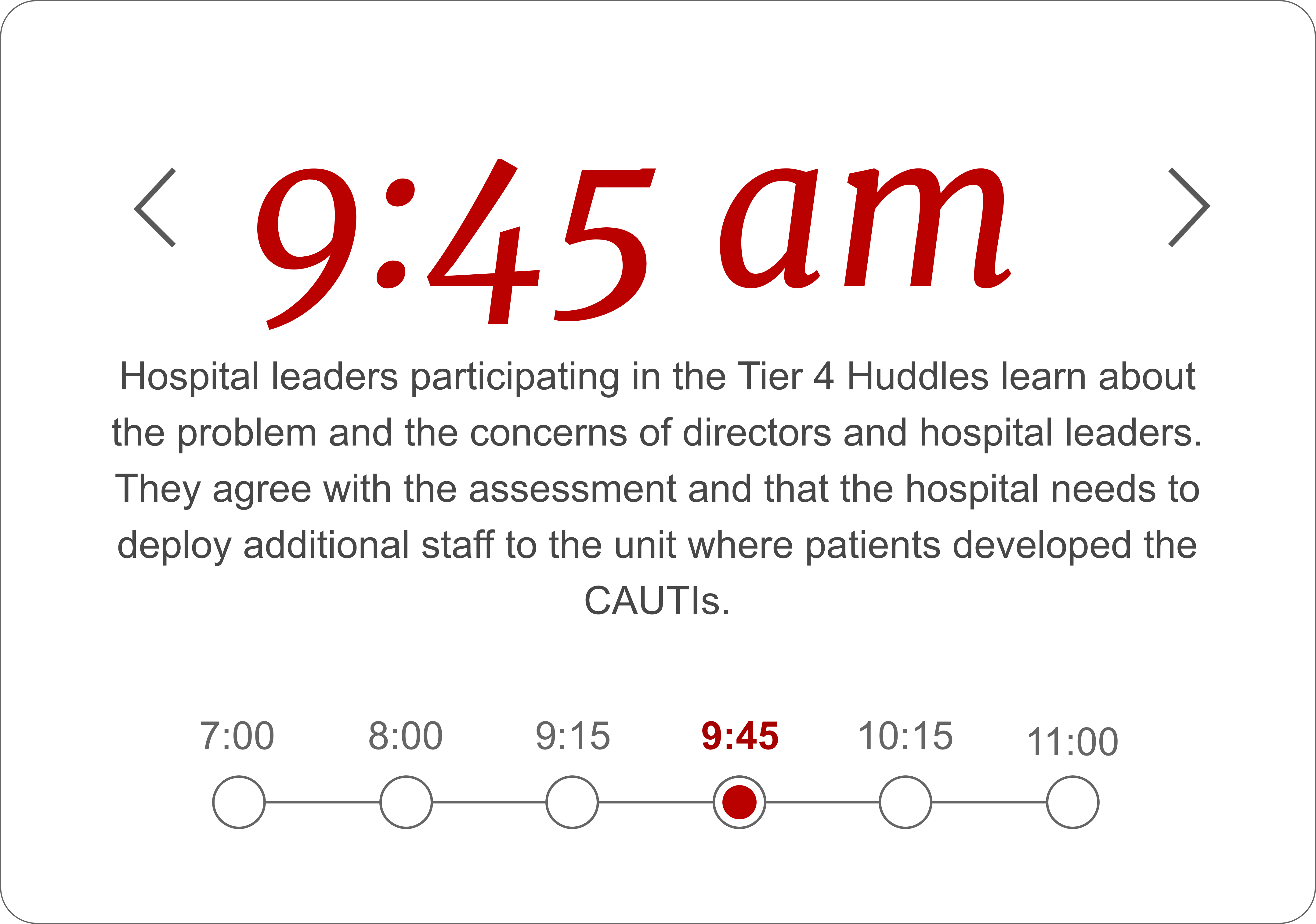
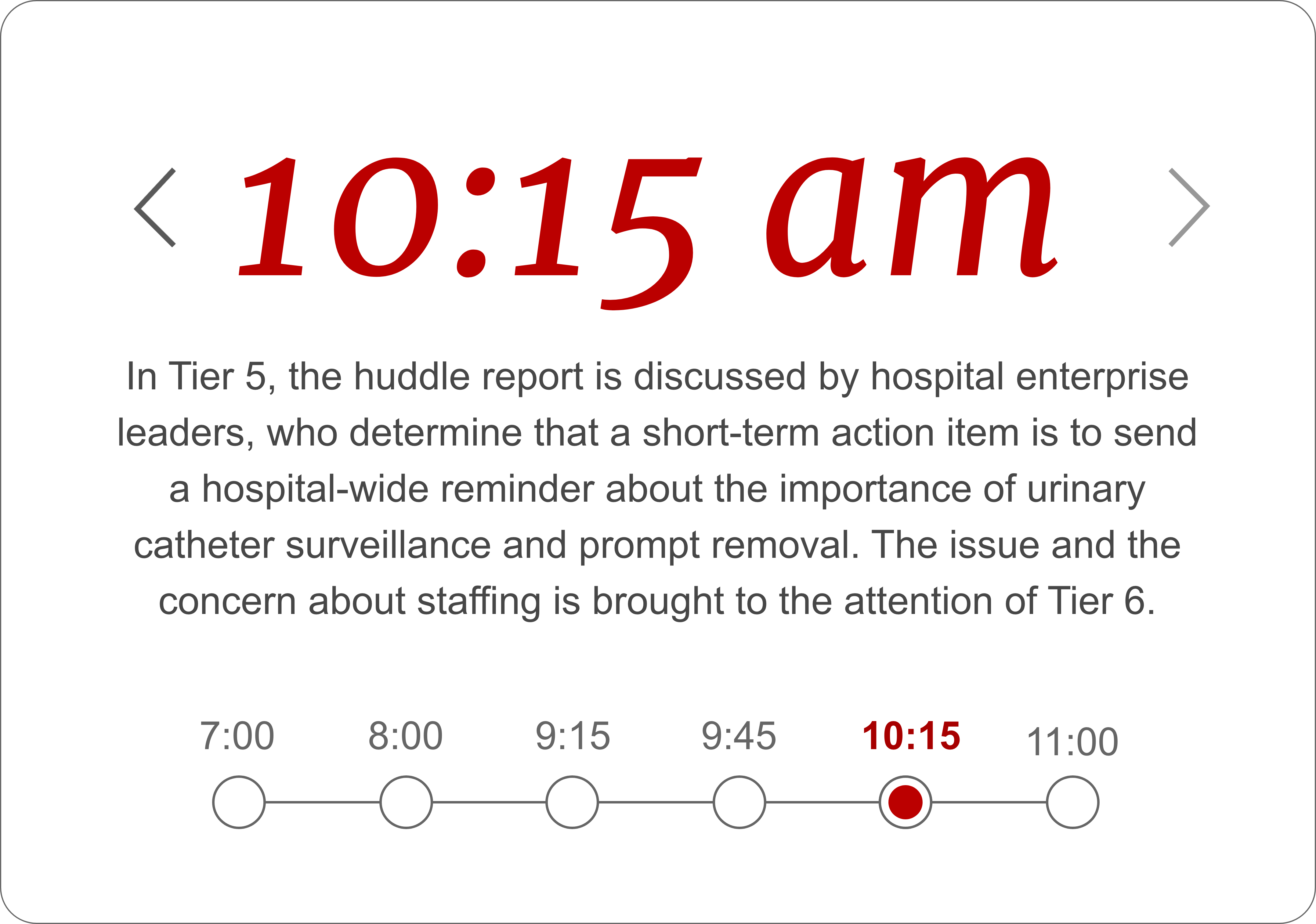
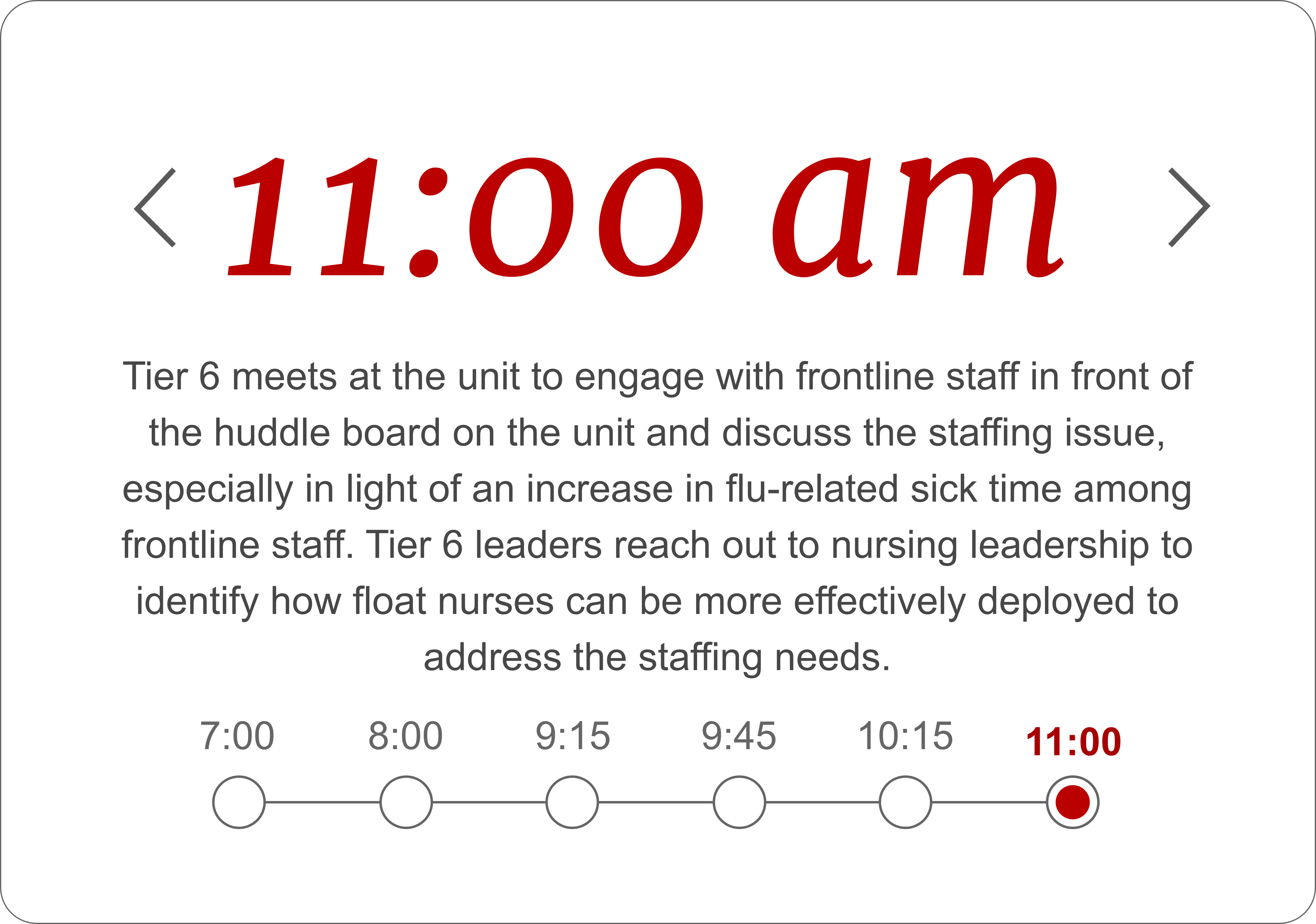
"So anything that's really pertinent goes all the way up the food chain on day one. I mean it just happens that quickly. The great thing about that is things then come back down. We look at follow-up. Every day we write down anything that we need communicated to our teams so that that communication comes back down to what we call the front-line caregivers. And so, that's as quick as we can problem solve." — Nursing Director
Tiered Huddles Components
This section provides a high-level overview of four main components to consider for effective Tiered Huddles to enable rapid communication of safety issues between frontline staff and executive level leaders. Activities and resources are provided to help implement each component of Tiered Huddles, and best practices are presented that should be considered for each of the components.
Huddle Boards
Overview
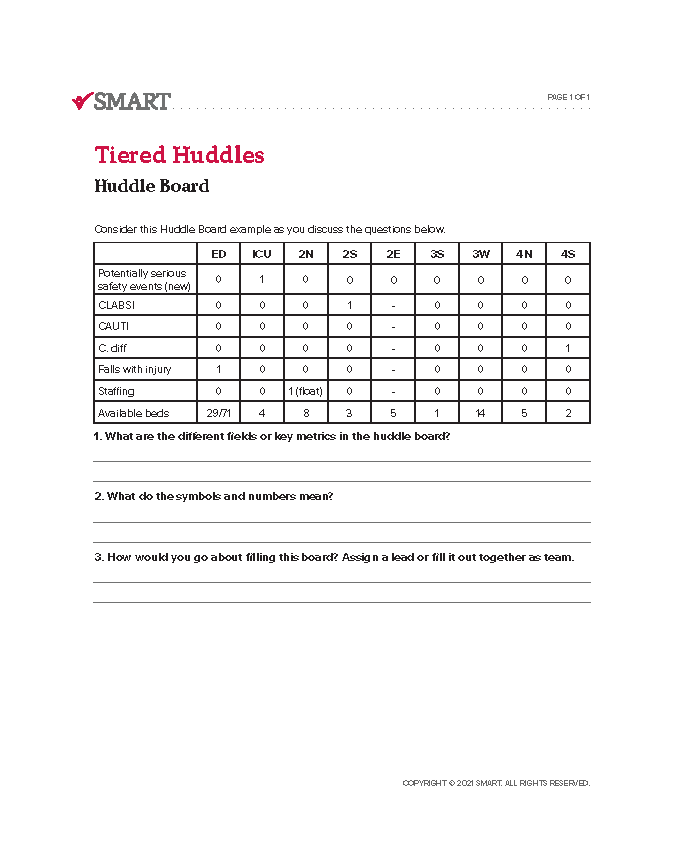
Huddle boards, which are typically white boards used by each huddle tier, contain standard metrics reported by huddle members to compare actual values of the metrics against target values and use this information during daily tiered huddles.
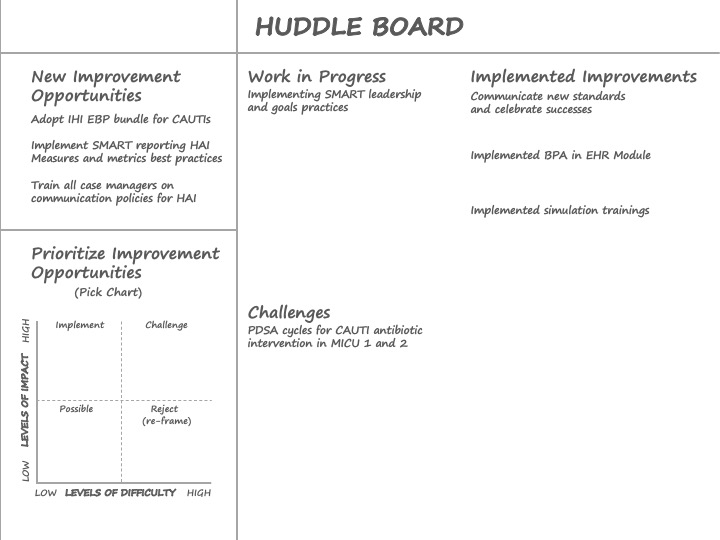
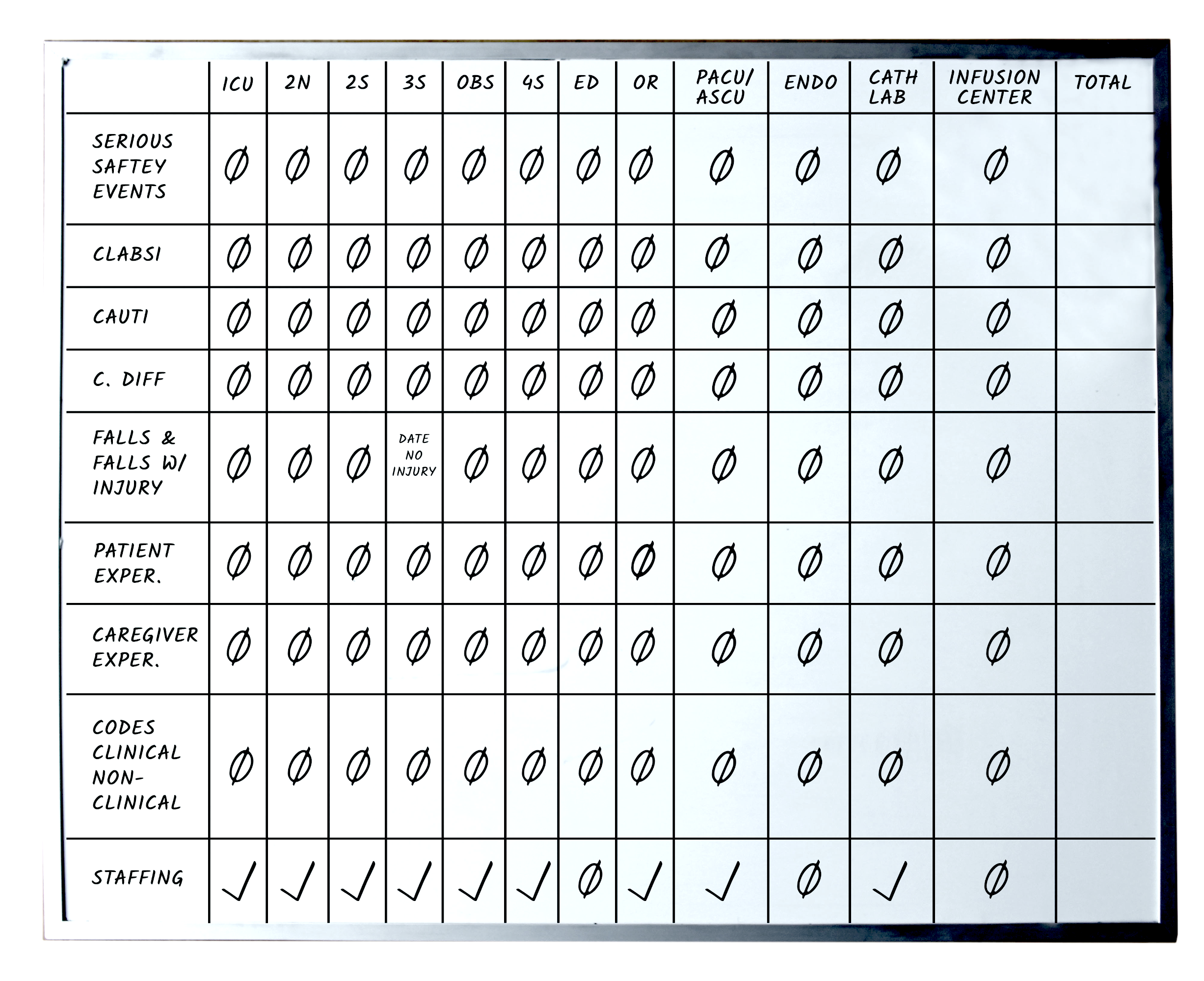
Examples of huddle boards. The design of the huddle board should be tailored to the outcomes that are important to the organization.
Implementation Guide: Huddle Boards
Facilitator and Implementation Guide
Portable Document Format (PDF)
This guide provides facilitators the information, considerations, and decision points to support organizational deployment of huddle boards.



Facilitator Companion Slides
PowerPoint Document (PPTX)
Presentation slide deck for facilitators to use during an organizational meeting to discuss designing and implementing huddle boards.
Activity
Tiered Team Huddles
Overview
Tiered Team Huddles are brief standing meetings that occur one or more times per day. According to the Institute for Healthcare Improvement, huddles should take place at the start of each shift and include a formal review of key metrics, problems, and action items.

An example schedule of Tiered Huddles
The figure illustrates a schedule of Tiered Huddles. Using a schedule like this, hospital leaders are made aware of patient safety issues by 11:00 a.m. every day. Huddles also should provide staff members an opportunity to discuss incoming patients and anticipate the needs or concerns of patients and team members.
Implementation Guide: Tiered Team Huddles
Facilitator and Implementation Guide
Portable Document Format (PDF)
This guide provides facilitators the information, considerations, and decision points to support organizational deployment of Tiered Team Huddles.

Facilitator Companion Slides
PowerPoint Document (PPTX)
Presentation slide deck for facilitators to use during an organizational meeting to discuss designing and implementing Tiered Team Huddles.
Tools
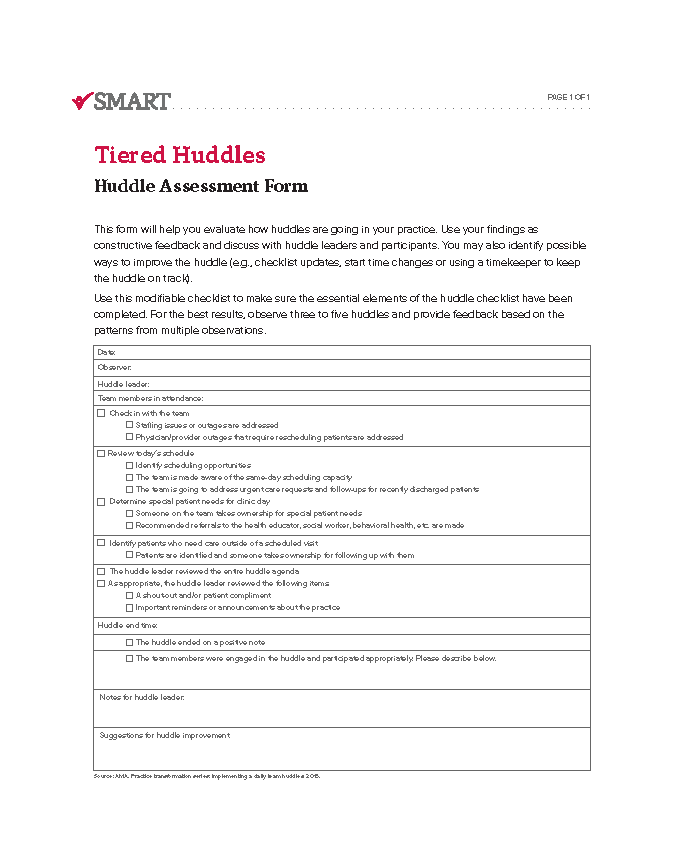
Huddle Assessment Form
Portable Document Format (PDF)
In small groups, explore the huddle evaluation checklist for huddles and discuss the questions on the handout.
Activity
Tiered Team Huddles Simulation
Portable Document Format (PDF)
This simulation describes how Tiered Team Huddles can be implemented by Frontline Managers and staff. This document also allows team members to consider how they will implement Team Huddles within different tiers.
Huddle Reports
Overview
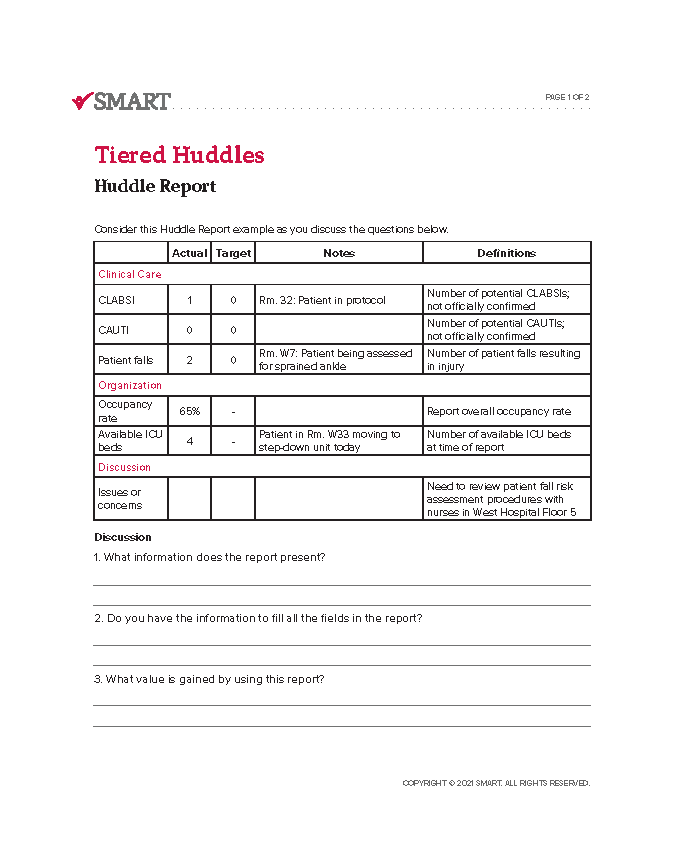
Huddle reports, which are documents to record daily performance by standard metrics, are used during daily huddles to primarily compare actual versus target values and document areas of concern. This document is relayed to different tiers for review.

An example of a huddle report. Information in this report allows information to flow efficiently across tiers.
Implementation Guide: Huddle Reports
Facilitator and Implementation Guide
Portable Document Format (PDF)
This guide provides facilitators the information, considerations, and decision points to support organizational deployment of huddle reports.
Facilitator Companion Slides
PowerPoint Document (PPTX)
Presentation slide deck for facilitators to use during an organizational meeting to discuss designing and implementing huddle boards.
Activity
Huddle Report Workshop
Portable Document Format (PDF)
This workshop provides participants the opportunity to explore an example of a huddle report and discuss specific questions to learn more about its use in practice.
Team Action Items
Overview
Huddle action items are specific responses that a tier can institute in response to a problem identified in the huddle report. Action items have associated status updates and specific contacts assigned to them.
| Date | Staff Assigned | Relevant Items | Status | Estimated Date of Completion |
|---|---|---|---|---|
| 09/12/20 | Dianne Crawford | Change location of storage for urinary | Complete | 09/22/20 |
| 11/24/20 | Rowan Carr | Revise policy on hand | In Progress | 02/28/21 |
| 12/07/20 | Sameer Tyson | Update EVB for CLABSI prevention | In Progress | 03/05/21 |
| 12/20/20 | Aanya Strong | Conduct root cause analysis for CAUTI incident in room 201 | Not Started | N/A |
Facilitator and Implementation Guide
Portable Document Format (PDF)
This guide provides facilitators the information, considerations, and decision points to support organizational deployment of huddle reports.
Facilitator Companion Slides
PowerPoint Document (PPTX)
Presentation slide deck for facilitators to use during an organizational meeting to discuss designing and implementing huddle boards.
Activity
Huddle Action Items Workshop
Portable Document Format (PDF)
This workshop provides participants the opportunity to explore examples of huddle action items and discuss specific questions to learn more about their use in practice.
Roles and Responsibilities
Frontline Managers
Frontline Managers, who are the leaders closest to patient care, provide this vital perspective to Tiered Huddles. They can leverage Tiered Huddles to promote teamwork around monitoring and resolving patient safety issues. Frontline Managers can use Tiered Huddles to harness clinicians' ideas and empower them to achieve patient safety goals. Tiered Huddles can help Frontline Managers to:
- Identify and establish metrics that drive success
- Discuss problems openly to enable learning
- Work with clinicians to identify the root cause of patient safety issues that can potentially lead to patient harm
- Elevate the concerns raised by clinicians higher up the organization
Tiered Huddles can open communication between Frontline Managers and illuminate problems that were once unknown.
Frontline Managers can use standardized approaches to data collection and reporting to help frontline clinicians understand the operational or patient safety issues that need attention. At the same time, Frontline Managers need to foster team participation for Tiered Huddle systems to work effectively. This means making sure clinicians are encouraged both to huddle frequently and to identify opportunities for improvement to provide safer patient care and reduce hospital infections.
Infection Preventionists
Infection Preventionists provide knowledge to Tiered Huddles that is essential to informed decision making at all levels of the organization.
Infection Preventionists can use Tiered Huddles to coordinate and work with other stakeholders to improve practice.
Infection Preventionists play a critical role in Tiered Huddles; their knowledge and clinical expertise in evidence-based practices provide the foundation for delivering safe patient care. The huddles allow Infection Preventionists to engage across the tiers on a daily basis, ensuring that best practices around infection prevention and control processes are demonstrated throughout the hospital. Tiered Huddles have been used to support hand hygiene and other infection prevention processes and facilitate the adoption of new programs to reduce the rate of infections.
Clinical Leadership
Tiered Huddles can help Clinical Leadership focus on ways to improve the care experience for both patients and clinicians. Clinical Leaders have the opportunity to learn about patient safety issues from frontline staff in a timely manner. The brief huddles can save Clinical Leaders valuable time because they allow them to quickly assess which hospital units are achieving their patient safety goals and which units may benefit from more clinical support to address infection prevention needs.
Clinical Leadership can use Tiered Huddles to improve patient and clinician care experience.
Administrative Leadership
The engagement of administrators in Tiered Huddles is critical to addressing challenges and making the changes necessary to reduce and prevent HAIs. An administrator can vocalize the goals and priorities of the organization to develop a strategy to address patient safety issues. Administrators should be present during huddles and be prepared to have a strategy to address patient safety issues.
Tiered Huddles create proactive leaders.
Tiered Huddles enable frontline clinicians and managers to communicate issues that need the attention of administrative leaders. When issues are raised, it gives administrative leaders an opportunity to understand what is not working and to think about system-wide challenges that need to be addressed.
Experiences From The Field
"So, basically we get to talk to the CEO every day. He gets that message by 11 o'clock."
"So anything that's really pertinent goes all the way up the food chain on day one. I mean it just happens that quickly. The great thing about that is things then come back down. We look at follow up. Every day we write down anything that we need communicated to our teams so that that communication comes back down to what we call the front-line caregivers. And so that's as quick as we can problem solve. And it's actually a great thing. At first it was difficult getting that momentum but I think people now really see it as an avenue for speaking up about problems quickly.""
"I love it [tiered huddles]. Because of what happens. What I hear or what I find out, the next day when I meet with my directors I say, 'Well please get this information, cascade it out to your teams.'"
"It's structure and accountability, yup! It is information coming up and then information coming back down."
Tiered Huddles Facilitator Guide: Complete
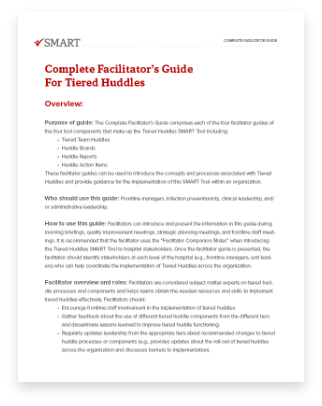
Facilitator Guide: Complete
Portable Document Format (PDF)
This guide provides facilitators the information, considerations, and decision points to support organizational deployment of team action items.
Facilitator Companion Slides: Complete
PowerPoint Document (PPTX)
Presentation slide deck for facilitators to use during an organizational meeting to discuss designing and implementing huddle reports.
Tiered Huddles Activity
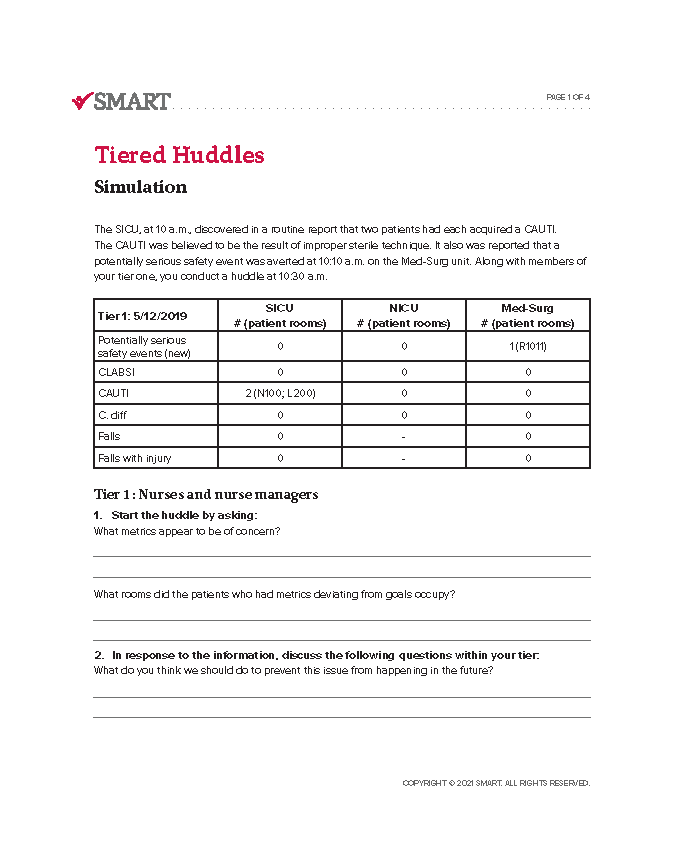
Tiered Huddles
Portable Document Format (PDF)
This activity will provide you and your team with the opportunity to apply your knowledge of all Tiered Huddles components together based on a simulated patient safety scenario. You and your team members can role-play members from different tiers so you can see the many different perspectives that may lead toward diagnosing and fixing a problem related to a set of events. Potential risks, challenges, and questions to motivate a conversation around this exercise are presented, and a competency check tests participants about their knowledge of the different components of Tiered Huddles.