What Are Rewards And Recognition? | SMART Toolkit

Rewards are tangible incentives used to motivate high performance in individuals and may take the form of things like paid time off (i.e., monetary), gift cards (i.e., tokens of appreciation), or trophies and certificates (i.e., emblematic).
Recognition is an acknowledgement of high performance communicated to individuals, either publicly or privately. These are typically non-financial, like a temporary or permanent title, and sometimes occur in concert with rewards.
Leaders can provide rewards and recognition to staff to highlight their impact on infection prevention. Importantly, rewards and recognition can occur at both the individual and unit levels.
Why Are Rewards And Recognition Important?
Recognizing the essential contribution of team members is an important factor in any role. With all the demands facing healthcare workers, managers can miss the opportunity to appreciate the work that they do.
When staff feel overlooked and underappreciated, this can lead to:
- A loss of interest and morale
- Resistance to change
- Decreased cooperation
- Reduced productivity
- Increased turnover
Rewards and recognition can increase staff engagement and can be a powerful tool in encouraging individuals' high performance.
When staff feel recognized and rewarded for their work, they experience increased:
- Motivation
- Morale and excitement
- Job satisfaction and retention
- Productivity
- Collaboration and teamwork
- Creativity and problem solving
When the importance of individuals is acknowledged, they are more confident in their ability to prevent avoidable HAIs.

"Different rewards and recognition really help motivate the staff and demonstrate the value of good infection prevention practices."
Designing Meaningful and Effective Rewards and Recognition
Systems that reward and recognize the contributions of staff frequently occur at many levels of the organization. While some organizations have system-wide reward and recognition programs, high performing hospitals have also instituted programs within departments and units.

One hospital developed a "golden catheter" award for CAUTI prevention where one of their units was recognized for the actions of unit-level staff. In another hospital, a nurse manager detailed recognition for the most helpful member of the staff who was given "angel wings" - a title for the week - while someone who had a more difficult week was given a cape made out of unit supplies. Photos were posted in the unit with awards given to both.
In any institution, leaders can think about how they acknowledge the contributions of staff. Recognition and rewards do not have to come from the organization as a whole; rather, they can come from individual leaders. Here are some considerations for leaders developing these programs.
Considerations for Delivering Rewards and Recognition:
Rewards and recognitions that embrace these considerations are going to reinforce excellence. When individuals don't know the actions that create rewards, they can't model the behavior required to receive them.
Who Approves?
Rewards and recognition can require signoff from various members of the organization. In some cases, organizations or departments establish a formal review process. In others, the award determination is more informal in nature.


Who Delivers?
Rewards and recognition can be delivered by a top-down approach (e.g. an Administrative Leader), a bottom-up approach (e.g. Frontline Managers to Administrative Leaders) from peer-to-peer (e.g. a colleague); or from an external stakeholder (e.g. patient representative or professional society). The impact of a reward or recognition can vary depending on who delivers it. For example, recognition from a national organization can be very prestigious but recognition by one's peers can be emotionally meaningful.

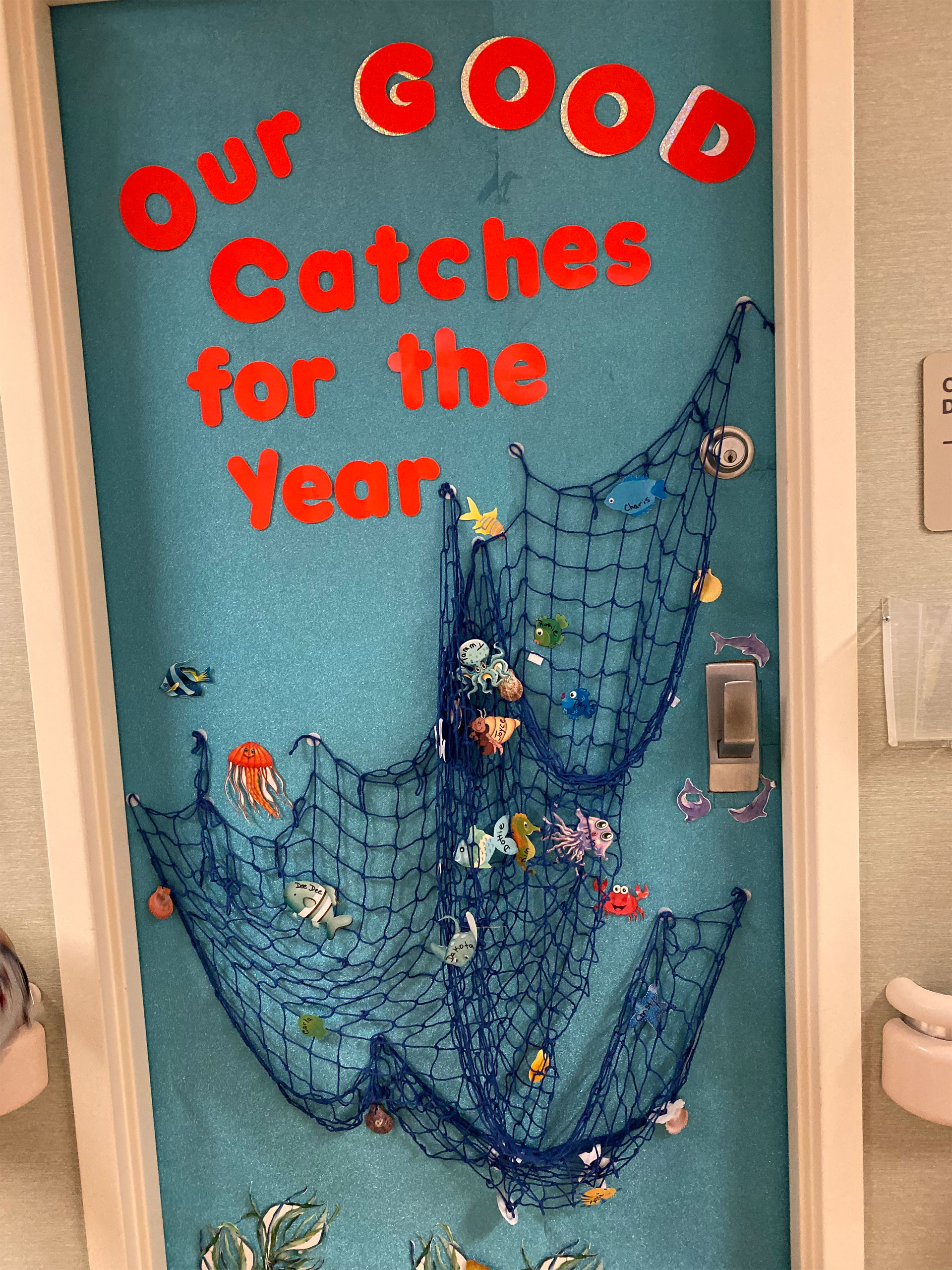
Photo taken during a study site visit.
How Often?
The frequency of the award could signal its importance, or it might take time for the award to be earned, suggesting consistency is valued. For instance, a unit may earn a pizza party if it reaches 100 days without an infection. In contrast, recognizing a "good catch" during a huddle is something that can happen as it occurs, and reinforces that the team needs to recognize those moments, regularly. One organization awarded the "golden catheter" weekly.
How Visible?
It is important that programs understand their audience. When programs acknowledge high performing individuals or teams, they are making the accomplishments of staff members visible. One-on-one praise or acknowledgement might be best for individuals who prefer that their performance or achievements remain private while group recognition may help in situations when an organization is attempting to establish a new, more transparent recognition program.


How Much?
Rewards and recognitions don't have to cost anything. If you choose to use one that has a cost, understanding who bears responsibility for it is important for the success of the reward program. For instance, offering paid time off may cost the organization, but offering a pizza party may cost a particular unit. What is important is consistency and to the extent that cost is a limiting factor, one should choose an approach that is sustainable in the long term.
Under What Conditions?
Programs should recognize behaviors and outcomes. The goal should be to "catch them doing good." Having transparent, clear, objective criteria can maintain fairness, buy-in and the legitimacy of the reward and recognition. When possible, consider the feedback of patients when deciding on which staff members deserve some time in the limelight.

Rewards For The Frontline
During our engagement across 2000 hours of interviews we heard lots of examples of how high performing hospitals had adopted approaches for recognizing their staff.
Safety Challenge Award

An emblematic reward is offered to all units or departments that meet or exceed hospital goals for CAUTIs and CLABSIs. The challenge is usually in the form of some objective standard - 100 days without an infection.
Excellence Award

An emblematic reward is offered to recognize excellence related to patient safety in the hospital. The award may be given out annually by hospital leadership, and generally is received in a public setting. Usually there is some emblem (trophy) that is associated with it.
"Last year we had trophies made up for different CAUTIs and CLABSIs and people who met those goals or exceeded them got little trophies to display on their unit."
Group Appreciation Award
A common form of rewards are food, and this recognition is well received. Token rewards can be offered to a group (i.e. unit) for events like reducing days for indwelling catheters by 15%. These rewards are often offered by either a Frontline Manager or an Administrative Leader. Important to note the financial cost associated with this approach that may require approval at additional levels in the organization.
"Yeah, so we just had a party, a big party…we had like a huge banner made that we hung outside. We made poster boards, and we ordered a cake. And we invited other units to come and celebrate our success."

Individual Appreciation Awards

Golden ticket (punch card for every foley removal to earn a float pass)
Individuals appreciate token rewards like coffee coupons at the hospital cafeteria. Managers can use these tokens on an ad hoc basis to recognize events like an individual for speaking up for patient safety.
While less expensive, these tokens still can bear a cost that may require approval at additional levels in the organization.
The “golden ticket” (left) is an example of a token reward offered to an individual by their Frontline Manager. This reward likely does not have a financial cost associated with it, but will require approval at additional levels in the organization.
Recognizing And Communicating Success
The rise of email and newer communication streams like Twitter and Facebook has meant that recognition can be something you do quickly, publicly and effectively. Below are examples of many of the types of recognition that can be used to show staff members that you value their work.

Recognition Email
Recognition messages for the accomplishments of individuals and teams can be sent and are often posted around the unit to get the word out about positive outcomes. Messages do not have a cost associated with them, but can be quite meaningful. They can be more formal in nature (see Script for Recognition Email) or informal (see Congratulatory Message from Top-level Leader), generally require no additional approval, and can come from all levels of the organization. Emails can be individualized, or when appropriate, sent as a group message.
Tools: Recognition Email
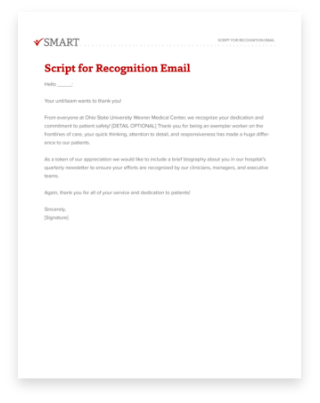

Message from Frontline Manager to Administrative Leader
"Bottom-up" recognition is the ability for Frontline Managers to bring attention to the success of staff to Administrative Leaders. This enables senior leaders to develop a targeted response (e.g., email, social media posting, etc.) to an individual's achievement and it gives Frontline Managers an easy approach to facilitate recognition of their staff. This informal approach can be used whenever a staff member or a unit crosses an HAI milestone, such as days without an infection.
Tools: Unit Success Email Script

Email Script of Unit Success to Administrative Leaders With Unit Copied
Portable Document Format (PDF)



Photo Recognition of Staff Members
Some hospitals recognize high performing staff by placing pictures of stand-out employees around the unit. Posting pictures of employees can improve the visibility of individuals, and among people that like public recognition, this can be more meaningful and enduring. Although the cost of implementing this approach is low, managers should check with administrators and staff before posting individuals' pictures in public spaces. Visual recognition can be either formal, such as framed photos of staff members as ‘Staff Member of the Month'; or can be more informal, such as creating a "Great catch" net with small photos of high-performing staff members integrated into it. Constructing a visual display board that promotes a unit's success can be a creative activity that involves both Frontline managers and staff.
Huddle Call-Outs
Compliance and good infection prevention practice can be called out in safety rounds and team huddles. For example, someone can be recognized during a huddle because they worked with hospital and unit administrators to close the loop on an existing safety issue related to CLABSIs. This recognition is an example of peer-to-peer recognition that takes a moment of time and has no cost. This also reinforces an important practice related to how members should function in their huddle.
Tools: Huddle Call-Out Examples

Hospital-Wide Recognition
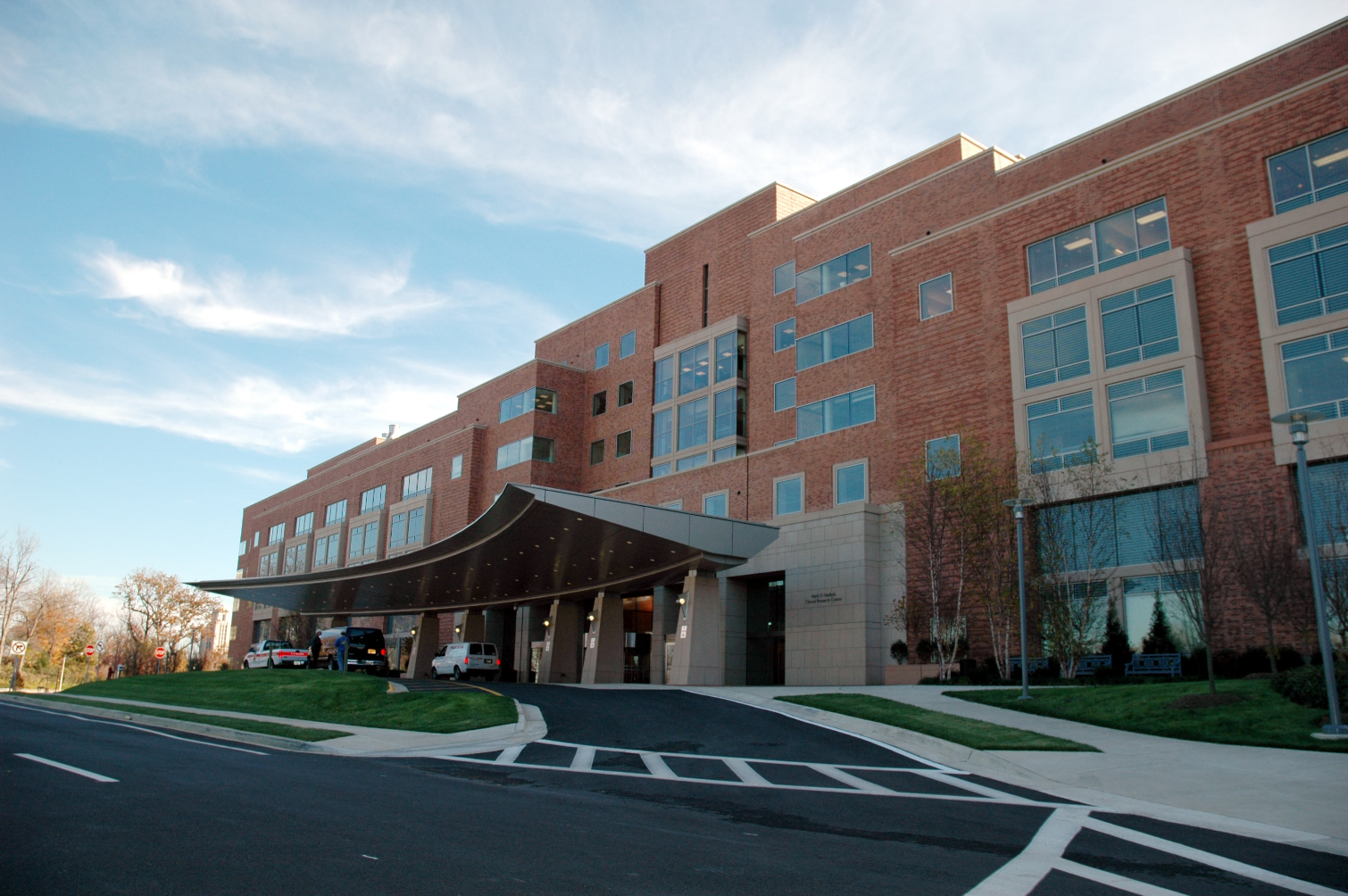
Organizations generally have communication venues, for example, emails, newsletters, and call-outs during institutional-wide meetings, that provide a platform to recognize successes among a wider audience. When a unit accomplishes a challenging patient safety goal, inclusion of that milestone can highlight the hard work of managers and staff while also suggesting opportunities to improve hospital performance. Although this mode of recognition does not have significant costs, hospital leadership should ask whether individuals or specific units want to be identified in hospital-wide messages.
Social Media
Social media outlets allow public displays of recognition. Most hospitals have tight restrictions on the content posted on their social media accounts, so this mode of recognition may require approval, though it typically does not have a cost associated with it.
Frontline Managers can use the organization's social accounts (e.g., Twitter, Facebook, Instagram) to call out achievements, such as reaching Magnet status. Social media can also be used as a secondary outlet to re-circulate recognition that was originally posted on the unit, expressed in-person, or communicated by email. Using social media can thereby improve the visibility of recognition both across the hospital and in the general public.
For example:
Tweet: Congrats to our incredible nurses named Nurse of the Year!

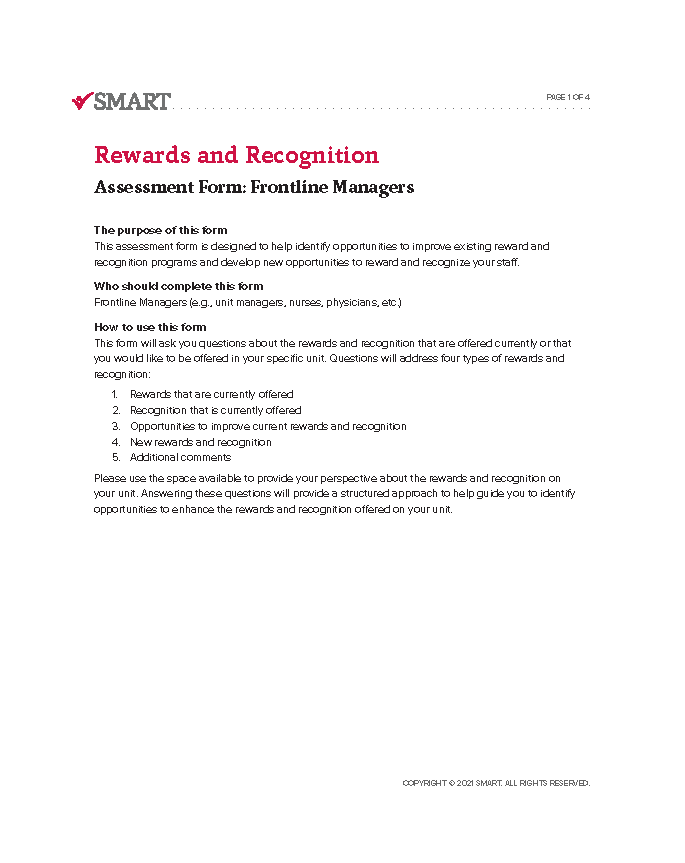
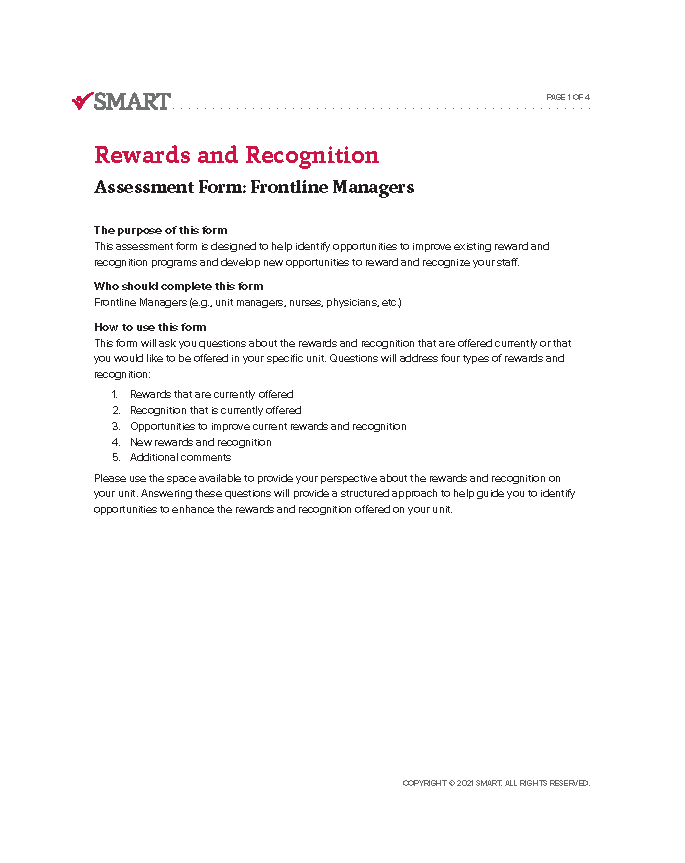
Tools: Assessment Form: Frontline Managers
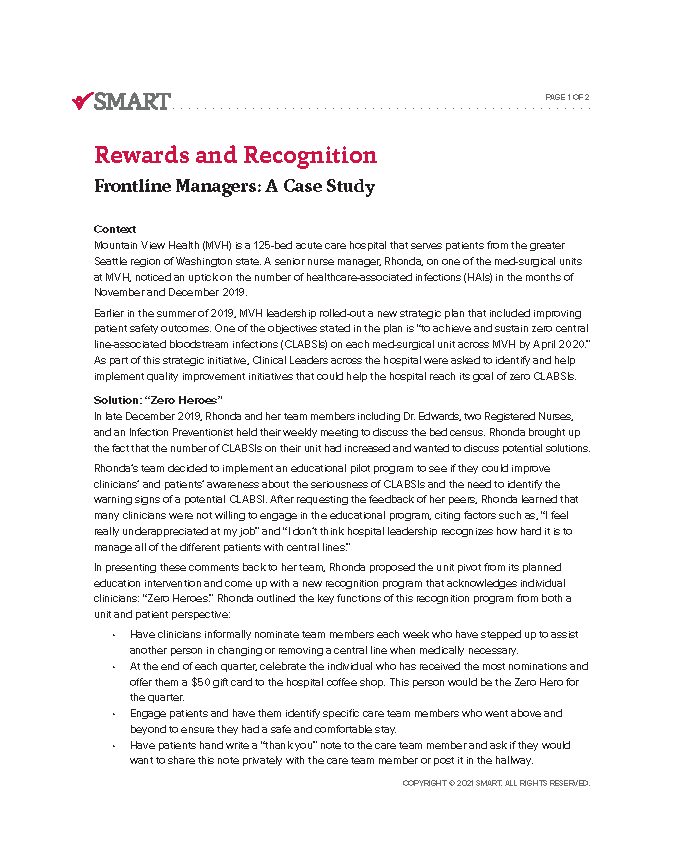
Activity: A Case Study: Frontline Managers
A Special Note About Administrative Leaders

As a result of the authority and visibility of their positions, Administrative Leaders, such as patient experience or quality and safety officers, play an outsize role in rewards and recognition. Administrative Leaders can support the use of reward and recognition programs through education and informing staff members regarding their importance, as well as helping to align reward and recognition programs with hospital HAI goals. Through these approaches, Administrative Leaders support a culture of rewarding and recognizing employees for high performance.
Administrative Leaders can also demonstrate to members of their organization examples of behaviors that deserve recognition, and assist with selection of metrics that relate to HAI performance to assess engagement and performance.
There are many factors for Administrative Leaders to consider as they seek to inform staff members about how to best use reward and recognition programs to achieve HAI goals and drive high performance.
Considerations For The Use Of Reward And Recognition Programs:
How To Communicate The Importance Of A Reward And Recognition Program

Administrative Leaders can communicate to Frontline Managers and staff, in both word and deed, the value of rewards and recognition. Mention of reward and recognition programs can vary in type and extend beyond reminders of their availability and reference prior achievements in a way that shows that these programs are valued.
Further, messaging should remind individuals and staff members about the importance of the acknowledgement, why it was achieved, and what it means to the organization. Just as important, these efforts should be consistent.
How To Use Rewards And Recognition To Complement Talent
Administrative Leaders can communicate how reward and recognition programs align with other talent management efforts, such as compensation, career development opportunities, or performance management.
For instance, talent management may want to provide financial incentives in employees' contracts based on HAI prevention or reduction achievements. These incentives can be very effective in supporting desired behavior from employees with respect to HAIs which could influence employee satisfaction and retention. Importantly, Administrative Leaders should pay attention to duplication of efforts in order to maximize resource allocation. If talent management supports a compensation plan that incentivizes high performance on HAIs, a reward program that offers paid time off for the same goal is likely duplicative and may not motivate performance gains.

Alternatively, offering career development opportunities related to leading patient safety efforts can also further support hospital HAI goals. These types of opportunities can be beneficial to employees because it allows them to engage in the development of policies and practices that can mitigate poor patient outcomes. For example, Administrative Leaders can nominate one or more nurses who have consistently advocated for patients on occasions when the patient's Foley catheter should be removed to serve on a patients safety council. In doing so, these nurses can provide recommendations for what they think could improve overall adherence to evidence-based care guidelines to reduce HAIs. These efforts, in addition to rewards and recognition, are all complementary, and work to reinforce the importance of HAI prevention.
Hospital Goals

Administrative Leaders can help to align hospital-wide patient safety goals related to rates of healthcare associated infections (HAIs) with rewards and recognition programs. This process begins by clear communication of HAI related goals from Administrative Leaders to Frontline Managers and unit staff.
Further, Administrative Leaders can support Frontline Managers by providing them with necessary data to assess HAI performance at the unit, team, or individual level. For instance, units or teams can be rewarded for having no reported HAI incidents during a defined period of time (e.g., monthly, quarterly, annually). This reward requires knowledge of HAI incidents over the defined period of time, and with this knowledge in hand this reward aligns to a hypothetical hospital-wide goal of zero HAIs.
How to Select Behaviors That Should Be Recognized and Rewarded
We know rewards and recognition programs are useful for reinforcing employee behaviors that are critical to HAI prevention (e.g., speaking up when noticing another teammate not following standard safety procedures for central line removal). However, it is important for administrative leaders to develop a system or process that will allow them to easily identify behaviors that make a difference. Leaders can start by participating in daily huddles and documenting examples or stories of how team members stepped up to help one another or their patients. Administrative Leaders can then report what they learned during these team huddles as well as identify and congratulate employees who went above and beyond to improve the quality or safety of patient care.
Furthermore, Administrative Leaders should determine how the performance of individuals and teams will be assessed (e.g., qualitative, quantitative, or both) and make this criteria accessible to all employees. Leaders who articulate clear and achievable criteria for success as well as communicate the ways the reward and recognition program will change over time (e.g., discontinuing the use of a trophy or certificate) can ensure that managers and employees use the program appropriately.
Examples For Administrative Leaders
Below we identify several examples of how Administrative Leaders can support the use of rewards and recognition that have been identified from other high performing hospitals as being meaningful to employees. As appropriate, we provide examples of these rewards and recognition so that you can begin using them today.
Bonuses and Perks
Financial bonuses and perks are linked to HAI performance metrics. Administrative Leaders can collaborate with talent management to identify opportunities to link employee bonuses to HAI performance metrics. Perks could include such things as flexible work schedules, selection of preferred shifts or days off, or premium parking spots.
Recognition Email (e.g., At the Unit or Organizational Level
Congratulatory messages from Administrative Leaders are posted around the unit. Administrative Leaders can observe team huddles to document examples of great teamwork that contributed to the prevention of HAIs.
Safety Challenge Award
An emblematic award is offered to all units or departments that meet or exceed hospital goals for CAUTIs and CLABSIs. The challenge is usually in the form of some objective standard, such as 100 days without an infection. It is important that Administrative Leadership supplies Frontline Managers with routine HAI incidence data.
Excellence Award
An emblematic reward is offered to recognize excellence related to patient safety in the hospital. The award may be given annually by hospital leadership, and generally is received in a public setting. Usually there is some emblem (trophy) that is associated with it. As part of the award, Administrative Leaders would describe why a unit was recognized and its importance to the organization.
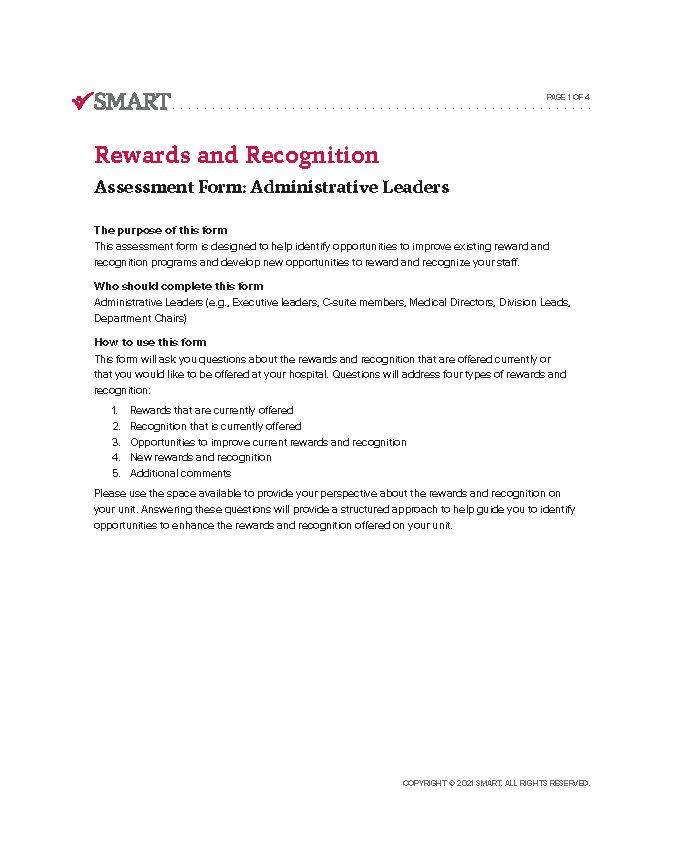
Tools: Assessment Form: Administrative Leaders
Tools: Assessment Form: Frontline Staff
Communicating HAI Information to Frontline Staff Assessment Form - Communicators
Portable Document Format (PDF)