Practicing the Art of Speaking Up, Interprofessionally | SMART Toolkit
When you notice a team member has broken sterile technique, or when someone fails to practice hand hygiene, speaking up is important. Yet, speaking up in these situations can be difficult, especially when speaking up to a team member in another profession, due to differences in norms, status, and perceived hierarchy. Research shows not all members of an interprofessional team feel comfortable speaking up, even when another team member is doing something that puts a patient at risk.
John, you didn't wash your hands and are about to put in a central line?
VS.
Did everyone wash their hands? We are about to put in a central line.

Sometimes speaking up may feel like attacking someone's competence or professionalism. As a result, people grapple with whether to say something. Others worry about personal consequences to professional relationships when speaking up, even when they see behaviors that carry a risk of harm to the patient.
Interestingly, speaking up is a skill that can be learned.
Skill Building Exercises Include:

Building confidence in speaking up
Practice speaking up when there is nothing on the line. Engaging in role-play exercises, or speaking up about small things outside of the work setting, can be a safe way to practice your skills.

Creating a safe environment to speak up
Leaders and others in positions of power can make team members feel safe to speak up by asking for feedback, making it clear that it is OK to disagree, and being receptive when a team member speaks up.

Depersonalization
Use language that makes it clear that this is about the issue, and not the person. This can make it easier for people to accept what you are suggesting.
Practicing these skills in simulated experiences can help support a culture where patient safety takes precedence. Perfecting these skills can contribute to confidence in an individual's ability to speak up, regardless of their role on the team, and can prepare team members to respond appropriately when someone does speak up.
Open Communication Is Key
Patients are almost five times more likely to experience major complications or death when their care team demonstrates poor communication.

Psychological safety is a belief that one will not experience negative consequences to self-image, status, or career for speaking up with ideas, questions, concerns or mistakes. In the context of clinical care, things like power differences between team members can interfere with these beliefs. Team members display different levels of assertiveness that depend in part on their training, experience, certification, and perceived role. In general, team members who believe themselves to have lower status are less likely to assert safety concerns.
Yet, we also know that poor communication is one of the top causes of adverse events.
It is possible to improve skills such as assertive communication through practice. Structured practice (training) has been associated with improvements in safety climate, reductions in medical errors, improved task performance, and reduced patient mortality.
Effectively communicating safety concerns is critical to preventing HAIs such as CAUTIs and CLABSIs.
Communication Crash Course

There are several situations in which speaking up is critical to patient safety and infection prevention, among them:
- Breaks in sterile technique during central line insertion
- Timely removal of Foley catheters
- Appropriate insertion point maintenance
- Failure to wear required PPE
- Non-compliance with hand hygiene
- Removing central lines when they are no longer medically indicated
Preventing HAIs requires every member of the team. Teams can work to empower individuals to both speak up and respond when patient safety concerns are identified. Preparing everyone on the team is critical to ensure communication about patient safety goes smoothly.
AHRQ's Team Strategies & Tools to Enhance Performance & Patient Safety (TeamSTEPPS®) is one of the most commonly used healthcare teamwork training programs. Among other knowledge, skills, and attitudes (KSAs), TeamSTEPPS® teaches learners various tools to increase their communication and conflict management skills - both areas that are crucial to the concept of speaking up. Additionally, AHRQ's Comprehensive Unit-based Safety Program (CUSP) provides information about developing a psychologically safe environment in which speaking up is supported. Both of these programs have tools and applications that can extend to teach learners to speak up within the HAI prevention context.
These communication overview tools were adapted from these programs for use in the context of infection prevention. For more information, these programs can be accessed at:
Communication Overview and Techniques for Speaking Up
SBAR
SBAR is a structured communication technique used to highlight meaningful, relevant information about a patient. It is usually used to provide the context needed for clinical decision making and to ensure that the care team has a shared understanding of the patient treatment.
While many use this approach for handoffs, it can also be used to structure a request or recommendation. For instance, it can be used to initiate a discussion about Foley removal.
SBAR stands for:
|
S |
Situation: What is going on with the patient? |
|
B |
Background: What is the clinical background or context? |
|
A |
Assessment: What do I think the problem is? |
|
R |
Recommendation & Request: What would I do to correct it? |
In practice, an SBAR interaction might look as follows:
Scenario:
A nurse is caring for a patient and is meeting with the physician for the first time today. The nurse wants to suggest that the Foley should be removed.
"I want to discuss Mrs. Li in Room 431. She is a 55 year old female who is admitted with heart failure and I'd like to talk about removing her Foley."
- Start by identifying the patient and providing a quick summary of their situation
"She had a Foley placed for urine output measuring. The Foley has been in place for 4 days."
- Provide the clinical background for the assessment
"Mrs. Li is now alert and oriented and we can measure her fluid status in other ways. She meets criteria for Foley removal."
- Give your assessment of the situation to reinforce your recommendation
"I recommend we remove the Foley. Is it OK to go ahead and do that?"
- Make a clear action statement related to your recommendation provide the clinical background for the assessment
Speaking Up For Sterile Technique:
Using the SBAR & DESC Script
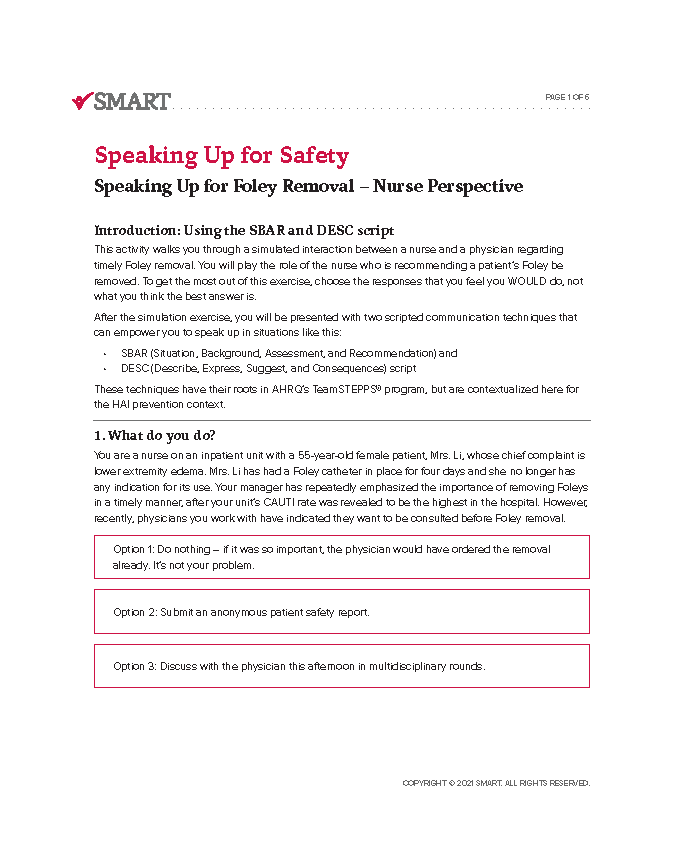
Using the SBAR & DESC Script Activity - Nurse Perspective
Portable Document Format (PDF)
This presentation allows your team to walk through a simulation of an interaction of a nurse with a physician around a lack of timely Foley removal. You will play the role of the nurse.


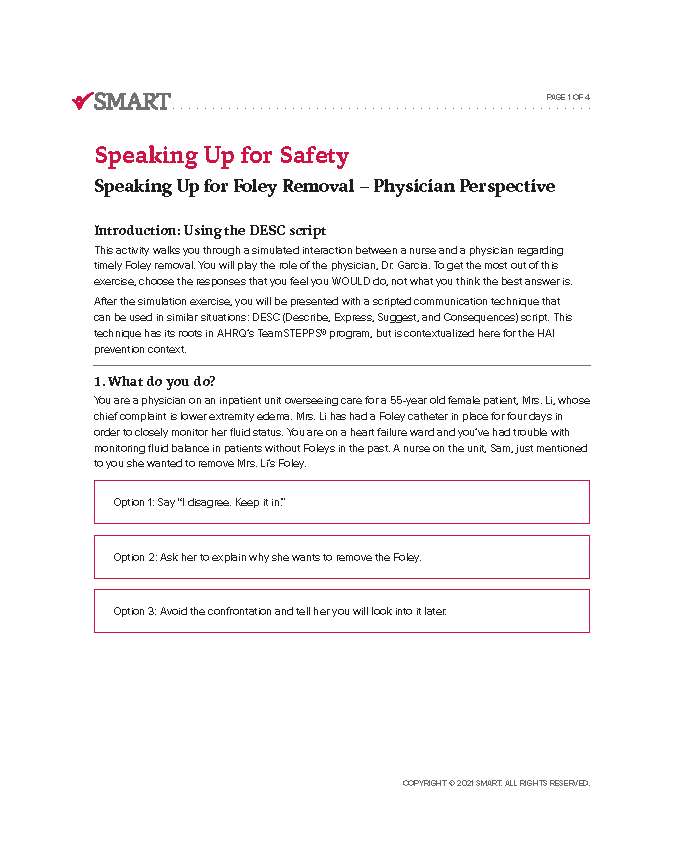
Using the SBAR & DESC Script Activity - Physician Perspective
Portable Document Format (PDF)
This presentation allows your team to walk through a simulation of an interaction of a physician with a nurse around a lack of timely Foley removal. You will play the role of the physician.
DESC Script
DESC is a structured communication technique used to manage and resolve conflict and disagreements. The DESC format can be followed to engage in conflict productively, by ensuring you convey the situation, your concerns, suggestions, and potential consequences.
The DESC script should be used when you are concerned about a task or process being done and team members have different points of view about the proposed action. DESC manifests your concerns about the process being used, and is best for situations that are not urgent as it tends to foster discussion about process.
DESC stands for:
|
D |
Describe the specific situation or behavior; provide concrete data. |
|
E |
Express how the situation makes you feel/what your concerns are. |
|
S |
Suggest other alternatives and seek agreement. |
|
C |
Consequences should be stated in terms of impact on shared goals; strive for consensus. |
In practice a DESC-based conversation might unfold as follows:
Scenario:
A nurse is caring for a patient and believes that her Foley should be removed. The physician has not responded favorably to the suggestion to remove the Foley and the nurse still believes the patient is best served by removing the Foley.
"Mrs. Li has shown significant improvement in sleepiness and confusion in the past 3 days."
- Describe the specific situation
"I am concerned that continuing the Foley is putting the patient at risk and is not necessary."
- Express your concerns about the action
"If you'd like, I can re-check Mrs. Li to ensure she is still alert and oriented, and report back the results to you within the hour. Would that make you more comfortable with removing her Foley?"
- Suggest other alternatives
"If we don't remove her Foley, she is at risk of developing a CAUTI."
- Consequences should be stated/Consensus should be reached
Speaking Up For Foley Removal:
Using the SBAR & DESC Script
Using the SBAR & DESC Script Activity - Nurse Perspective
Portable Document Format (PDF)
This presentation allows your team to walk through a simulation of an interaction of a nurse with a physician around a lack of timely Foley removal. You will play the role of the nurse.
Using the SBAR & DESC Script Activity - Physician Perspective
Portable Document Format (PDF)
This presentation allows your team to walk through a simulation of an interaction of a physician with a nurse around a lack of timely Foley removal. You will play the role of the physician.
Two Challenge Rule
The Two Challenge Rule can be used to introduce a concern, and can be of particular benefit when a person feels their concerns are not being addressed. While each member of the team is responsible for asserting their concern, sometimes in moments they can fail to be heard.
By reinforcing concerns twice, the individual increases the impact of their concerns and is more likely to be heard by other team members. At any time, other members of the team can hear these concerns and also reinforce them through a second challenge, empowering individuals to engage in the process as a collective, as opposed to individually. The fact that anyone can issue the second challenge, means this tool goes to the heart of teamwork - individuals may observe an issue but the team is responsible for resolving it.
If the issue still hasn't been acknowledged, the individuals should feel empowered to "stop the line" or escalate up the chain of command.
In practice, a Two Challenge Rule interaction might look as follows:
Scenario:
A nurse is in a patient room assisting a physician with central line placement. The nurse observes the physician putting on a sterile gown and gloves without first performing hand hygiene.
Challenge #1:
"It looks like we may have missed some hand hygiene steps. Has sterile technique been broken?"
Challenge #2:
"I'm uncomfortable moving forward with this procedure since sterile technique may have been broken. I'm
stopping this procedure. We can start again."
- "Good catch. Let's start over."
Speaking Up For Sterile Technique:
Using assertive communication, CUS, and the Two Challenge Rule
Using the SBAR & DESC Script Activity - Nurse Perspective
Portable Document Format (PDF)
This activity walks you through a simulated interaction between a nurse and physician regarding the sterile insertion of a central line. You will play the role of the nurse who identifies a break in sterile technique during the central line insertion procedure.
CUS Framework
The CUS Framework is a communication framework that uses signal words to relay safety concerns in such a way that all team members can understand the seriousness of the concern. When all team members are aware of these signal words, their use can clearly communicate safety issues and their seriousness.
The CUS framework is particularly useful to convey emergent patient safety concerns.
CUS stands for:
|
C |
I am concerned |
|
U |
I am uncomfortable |
|
S |
This is a safety issue |
In practice, the use of the CUS framework may look like:
Scenario:
A nurse is observing a physician insert a central line and notices a break in sterile technique.
"I am concerned sterile technique has been broken."
- State your safety concern.
"I'm uncomfortable moving forward with this procedure because our team has broken sterile technique."
- Explain why you are uncomfortable because of this safety concern.
"This is a safety concern and we need to stop and start over. We don't want this patient to end up with a CLABSI."
- If the issue is not resolved, state there is a safety concern. If the issue is still not acknowledged, notify your supervisor or use your chain of command.
Speaking Up For Sterile Technique:
Using assertive communication, CUS, and the Two Challenge Rule
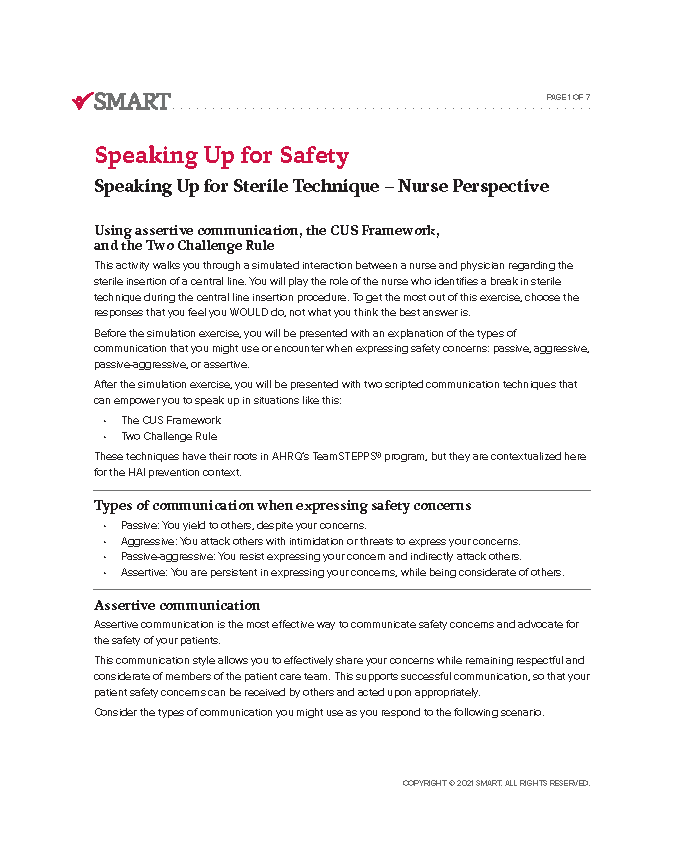
Activity Nurse Perspective
Portable Document Format (PDF)
This activity walks you through a simulated interaction between a nurse and physician regarding the sterile insertion of a central line. You will play the role of the nurse who identifies a break in sterile technique during the central line insertion procedure.
Creating Psychological Safety
The highest performing teams have psychological safety - the shared belief that team members will be supported when they make a mistake, ask for help, or speak up. Psychological safety can facilitate the use of team strategies and tools (e.g., CUS) that help to reinforce the importance of speaking up to address patient safety issues.
Team leaders can use the following phrases to increase psychological safety and to show that they support speaking up in their team (AHRQ, 2018):
"If you see anything amiss, please speak up. We're a team and we have to have each other's backs."
- Promote team inclusiveness.
"It's fine to disagree. That's why we're talking about this together."
- Not being rude, disrespectful, or belittling to team members.
"Just like they say at the airport - 'If you see something, say something.'"
- Explicitly encouraging team members to speak up.
"Thanks for pointing out my mistake. You just saved me from a big blunder."
- Promoting learning from one another.
"I'm not sure I've done this right. Can someone check me?"
- Acknowledging the limits of their own knowledge.
Speaking up for Sterile Technique:
Psychological Safety For Safe Hospital Systems
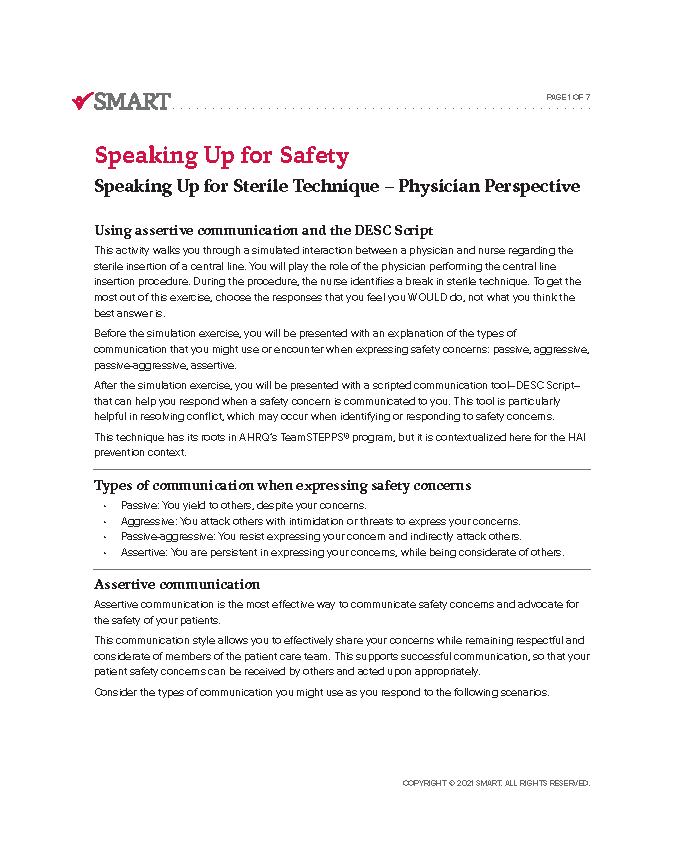
Activity Physician Perspective
Portable Document Format (PDF)
This activity walks you through a simulated interaction between a nurse and a physician regarding hand hygiene prior to central line placement. You will play the role of the physician. To get the most out of this exercise, choose the responses that you feel you WOULD do, not what you think the best answer is.
Roles and Responsibilities
Frontline Managers can support the practice of speaking up to prevent HAIs by:
- Training frontline staff in the use of effective interprofessional communication strategies, and
- Empowering frontline staff to speak up (and respond) as they encounter patient safety concerns.
Frontline Managers can support appropriate training and empower staff to speak up.
Communication among the care team is critical to high quality patient care. Effective communication is crucial when team members need to speak up in response to safety issues. Speaking up can be uncomfortable and takes training to know how to do it right. Frontline Managers can support members of the care team by providing strategies for effective communication when speaking up for patient safety. When everyone is aware of these strategies, speaking up becomes a powerful tool to keep patients safe.
Orient Infection Preventionists to encourage clinicians' use of the speaking up tools.
Infection Preventionists provide expertise and leadership around best practices for infection control in hospitals. By clearly communicating patient safety concerns to frontline clinicians and leadership, they can help support a culture where clinicians feel comfortable speaking up about patient safety issues.
In addition, Infection Preventionists can disseminate best practices among frontline staff through simulation training. This training gives the opportunity to review best practices and common errors and address them in a safe environment.
Speaking up on an interprofessional team can be intimidating. By using effective interprofessional communication, and encouraging team members to speak up, Clinical Leaders lead by example. Clinical Leaders can facilitate communication by creating a psychologically safe culture where all members of a team feel comfortable speaking up.
Clinical Leaders leverage their experience and expertise to identify where increased communication training can have the greatest impact.
Hospital Administrators set the expectation for the organization that speaking up saves lives. Clinicians may feel hesitant when speaking up, particularly in interprofessional teams where hierarchy and power differences may cause some individuals to feel uncomfortable communicating concerns.
Clinicians feel more comfortable speaking up when they are sure they are supported by the organization. By providing effective communication strategies and supporting their use during clinical encounters and team meetings, Administrative Leaders make individuals feel like speaking up is a valued contribution to the process of patient care.
Leadership must support and empower clinicians to speak up for safety.
Administrative Leaders can support and improve interprofessional communication by directing Frontline Clinicians, Infection Preventionists, and Clinical Leadership to engage in these simulations, which can be done independently and with nothing more than a computer.
Experiences from the Field
"I think we still struggle with escalation. I mean nurses see things coming and don't speak up fast enough, we know that. We work on that all the time. I think that the answer to that is simulation and we do a good job now kind of bringing medical students and nursing students and physical therapy students together to the lab and let them learn and grow together. And that's great because we retain those folks."
"Always empowerment, we talk about that all the time, you know how do you stop something that you're seeing somebody else do that might harm your patient. So I think you know in that particular room having all of our physician leaders and anesthesia leaders who have empowered nurses to speak up and stop their peers when they were trying to insert a central line without the appropriate gown. Just empowerment and speaking up. A lot of work was done on multiple teams, infection prevention was very involved in that."
"We do as part of our orientation, not house-wide, they go through simulation and it's an interdisciplinary simulation and it's a deteriorate patient simulation in the sim lab and so the physicians, the residents, and the nurse, the new nurses, go together over there and one of the things we focus the most on in that simulation in the debrief is communication. So is for physicians not to just shout stuff into the air and think it's going to happen."
"So we say excuse me and we say I think you missed an opportunity to wash your hands. And from our CEO [chief executive officer] the only response to that statement is 'thank you.' because we've had push-back where they'll get nasty. So about a year ago our CEO put his foot-down and said to everyone, 'Get the message out that if someone reminds you to wash your hands, the only response is thank you.'"
"The one that probably has been the hardest, but I feel like is starting to make a difference is ARCC [Ask, Request, Concern, Chain of Command]. …So it's kind of flattening that hierarchy to say it doesn't matter whether you're the housekeeper or the chief medical officer, if you see someone about to make a mistake, you not only should you speak up, you're accountable to speak up. So we have this ARRC: ask a question, so 'doctor, are you really going to pick that tablet up?' 'yes I'm going to do that.' You request a change, then you voice a concern…ARCC…then you voice a concern and if those three things don't work, then you take it up the chain of command. So ask a question, request a change, voice a concern, take it up the chain of command."
"So, we had kind of started with those tools, they have different names but they are really similar tools, and really worked to change the culture and that it is okay to speak up. Because when it is not the culture it is uncomfortable for people, but it is the expectation there and I feel like… our medical director at the time, he actually helped teach the class because he felt like as a doctor, the nurses can speak up to him too, and he has led that example on the unit and I think it has made a huge difference."
"We always have that saying, 'See something, say something.' Speak up, I have a question, I need a moment, or whatever that saying we have. Those kinds of things we try to ingrain in staff that we would rather you ask 50,000 questions than just to think, 'Eh, I think I know what I'm doing,' and not say anything. So that's pretty much the culture we've tried to instill."
"I mean there's the, you know, chain of command and ask questions, and there's the stand down phrase, 'I need a moment, I have a question,' where it is supposed to be the stop everything, no questions asked. So there has been education there, but I think there's always… you get yelled at a couple times you're going to be less likely to speak up, no matter how much support you're going to get after the fact. So some of it has to be how the hospital handles that blowback from a physician."
Facilitator Guide: Speaking up for Safety
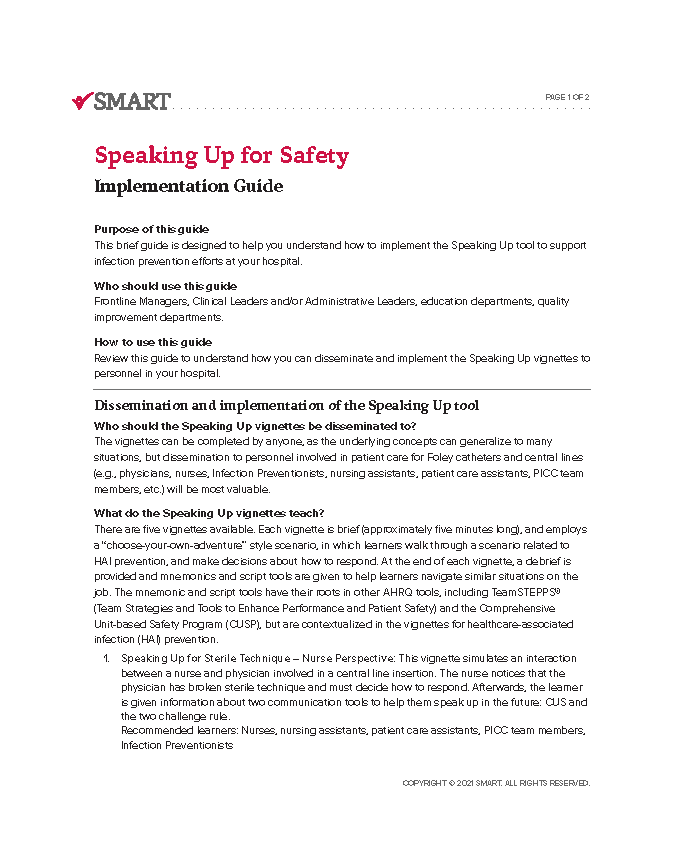
Facilitator Guide: Complete
Portable Document Format (PDF)
This brief guide is designed to help you understand how to implement the Speaking Up tool to support infection prevention efforts at your hospital.
Works Cited & References
- Agency for Healthcare Research and Quality. TeamSTEPPS 2.0. Content last reviewed June 2019. Available from: https://www.ahrq.gov/teamstepps/instructor/index.html
- Agency for Healthcare Research and Quality. Creating psychological safety in teams. 2018. Available from: https://www.ahrq.gov/sites/default/files/wysiwyg/evidencenow/tools-and-materials/psychological-safety.pdf
- Hughes AM, Gregory ME, Joseph DL, Sonesh SC, Marlow SL, Lacerenza CN, Benishek LE, King HB, Salas E. Saving lives: A meta-analysis of team training in healthcare. Journal of Applied Psychology. 2016 Sep;101(9):1266-1306.
- Mazzocco K, Petitti DB, Fong KT, Bonacum D, Brookey J, Graham S, Lasky RE, Sexton JB, Thomas EJ. Surgical team behaviors and patient outcomes. The American Journal of Surgery. 2009. 1;197(5):678-85.
- Sutcliffe, K. M., Lewton, E., & Rosenthal, M. M. (2004). Communication failures: An insidious contributor to medical mishaps. Academic Medicine, 79, 186 -194.
- The Joint Commission. (2014). National patient safety goals effective January 1, 2014: Hospital accreditation program. Retrieved from http://www.jointcommission.org/assets/1/6/HAP_NPSG_Chapter_2014.pdf
- Wagener F, Ison DC. Crew resource management application in commercial aviation. Journal of Aviation Technology and Engineering. 2014;3(2):2.
- Greene MT, Gilmartin HM, Saint S. Psychological safety and infection prevention practices: Results from a national survey. American Journal of Infection Control. 2019;48(1):2-6.